Indicators

Accumulation And Distribution Line
Adaptive Moving Average
Adaptive RSI Indicator
Adaptive TSI
ADX (Average Directional Index) Indicator
Alligator Indicator
AMMA Indicator
Aroon Indicator
Aroon Oscillator
ATR Based SMA
ATR Deviation Ranking
ATR Percentile Indicator
ATR Rank Indicator
ATR Stop-loss Indicator
ATR% (Average True Range)
Average Column Length
Average Daily Range (ADR)
Average Return
Average Trend
Average True Range [ATR]
Awesome Oscillator
Balance of Power
BBA Volatility Squeeze
BCI Indicator
Bollinger Band
Bollinger Band Size
Bollinger Bandwidth
Bollinger BTV Indicator
Brick Count Indicator
Brick Indicator
Brick Zone
Bull Bear Session counter
CAGR
Camarilla
Candlestick Momentum Index [CMI]
Candlestick Momentum Index with TSI [CMIT]
CCI (Commodity Channel Index)
Center Of Gravity
Chaikin Volatility
Chande Kroll Stop Indicator
Chikou Span
Choppiness Index
CMB Composite index
CMO
Column Length
Connors RSI
Coppock Indicator
Count-Moving Average Indicator
CRSI
D Cap-Shoe RS Indicator
D Disparity Dots – D Smart
D Disparity Dots – Super trend
D Momentum Pullback
D Momentum Pullback Indicator
D Smart Line
D-Disparity Dots Indicator
DCA Volatility Squeeze
Detrended Price Oscillator (DPO)
Discrete Moving Average
Disparity Index Indicator
DMA Histogram
Donchian Bandwidth
Donchian Channel
Double Exponential Moving Average (DEMA) Indicator
Double Moving Average
Double VWAP (Moving VWAP Crossover)
DTDB Indicator
Ease of Movement
Efficiency
Efficiency Ratio
Elder Impulse System
Elder Ray Index
Force Index
Forward Displaced Moving Average
Fresh vs Running
Gain Loss Count Indicator
GAPO Indicator
Guppy Multiple Moving Average
High Low Indicator
High Low Momentum Index
High Low Retracement
Hull Moving Average
Ichimoku Indicator
Intra VWAP
Intra VWAP Disparity Index
Intra VWAP Histogram
Intraday Momentum Index [IMI]
Keltner ATR
Keltner Channel
King Oscillator
KST - Know Sure Thing Indicator
MA Envelope
MA Score Indicator
MACD
MACD Histogram
MACD_V
MACD% Indicator
MACI (MA Convergence)
Mansfield Relative Strength
Mass Index
MAST Indicator
Money Flow Index [MFI]
Moving Average Channel
MP RSI Indicator
Multiple ROC%
Negative Volume Index (NVI)
No of days in P&F chart
Noise Rate Indicator
OIWAP (Open Interest Weighted Average Price)
On Balance Volume [OBV] Indicator
Parabolic SAR (PSAR)
Percent Away From MA
Percent B Indicator
Percentage Price Oscillator (PPO)
Percentage Volume Oscillator (PVO)
Performance Indicator
PIVOT Indicator
PMOX Indicator
Price by time
Price Median
Price Momentum Oscillator (PMO)
Price Rekha Indicator
Price Strength Index
QQE
Quality Action Indicator
Range Marker
Rank Index
Ratio Chart
Ratio Rank Indicator
Ratio RSI Indicator
RAVI
RDX
Relative Strength - Alpha Vol
Relative Strength – Alpha
Relative Strength Index (RSI)
Relative Volume (RVOL)
Return-Range Indicator (RRI)
RMI
ROC ABS
ROC%
Rohit’s Long Momentum Indicator
Rohit’s Momentum Indicator
Rohit’s Short Momentum Indicator
Rotation Factor
RS-NV
RS-TVR
RSI Cumulative Indicator
RSI Histogram
RSI Streak Indicator
RSI-sum indicator
Safe Zone
Senkou Span B
Shadow Rate Indicator (SRI)
Shadow%
Single Moving Average
Single VWAP
Smoothed Relative Strength Index
Smoother MA
Special K
Standard Deviation [SD]
Stochastic RSI
Stochastics Indicator
Stretch
Super Swing Line
Super Trend Indicator
Swing Line Indicator
Swing Price Volume Indicator
TMA Trend
Triple Brick Indicator
Triple Exponential Moving Average (TEMA) Indicator 
Triple Moving Average Indicator
Triple VWAP Indicator
Triple XO Indicator
TRIX Indicator
TS100 Indicator
TSI Indicator
TTM Squeeze
Turtle Bands - Bearish
Turtle Bands - Bullish
Typical Price – Average
Ulcer Index
Ultimate Oscillator
US-LS
Volar
Volatility
Volume
Volume Double Moving Average
Volume Rate of Change%
Vortex Indicator
VWAP ATR Bands
VWAP Bollinger Bands
Weightage close
Weighted ROC
WilliamPro_Go
WilliamR
X Ratio
XO AMA
XO Count
XO Indicator
XO Line
XO Strength
XO Volatility
XO Zone
XO Zone with Average
Z Score

TS100 Indicator

#momentum #oscillator #dual-smoothing 

TS100 is a momentum oscillator that tells you whether short-term momentum is stronger or weaker than long-term momentum.. 

TS100 is a momentum oscillator that oscillates around a centerline of 50. It uses a dual-smoothing approach: one fast smoothing layer and one slow smoothing layer applied to price changes. The fast layer captures recent momentum. The slow layer captures longer-term momentum. The ratio between them determines whether the oscillator is above or below 50. When fast momentum exceeds slow momentum, the line rises above 50 — bullish. When slow momentum exceeds fast momentum, the line falls below 50 — bearish. 

Default periods: 14 (fast) and 26 (slow) 

How to read it: 

A single line that oscillates around 50. Above 50 means short-term momentum is ahead of the longer-term trend — the move is accelerating. Below 50 means short-term momentum is lagging — the move is losing speed. The line is smooth and stays in place during real trends, then flips decisively when momentum genuinely changes. 

Useful readings: 

– Above 50 — bullish momentum zone. The trend is gaining speed. 

– Below 50 — bearish momentum zone. The trend is losing speed. 

– Crossing above 50 — momentum has shifted from weak to strong. Trend change may be starting. 

– Crossing below 50 — momentum has shifted from strong to weak. Trend change may be starting. 

– Steep rise above 50 — momentum is accelerating fast. Strong trend. 

– Steep fall below 50 — momentum is deteriorating fast. Strong reversal. 

– Price makes new high but TS100 doesn’t — momentum is fading despite the price move. Trend exhaustion. 

Use cases: 

– Trend direction: Above 50 = trend is alive. Below 50 = trend is dead. Simple filter for whether to be long or short. 

– Entry timing: Enter on the 50 cross — you’re getting in when momentum shifts, not when it’s already exhausted. 

– Divergence trading: When price and TS100 disagree, the trend is running out of steam. That’s a reversal warning. 

– Noise filtering: The dual-smoothing keeps the line from flipping back and forth in chop. When it does move, it means something. 

Objective rules: 

– Go long when TS100 crosses above 50. 

– Go short when TS100 crosses below 50. 

– Exit when it crosses back through 50 in the opposite direction. 

– Avoid trading when TS100 is flat around 50 — momentum is neutral. 

– Use divergence (price vs TS100 disagreeing) as an early exit signal. 

What makes it unique: Most momentum oscillators compare price to a single average. TS100 compares two layers of momentum against each other — fast vs slow. That double-smoothing removes the noise that makes most oscillators whipsaw. The result is a cleaner signal that stays committed during real trends and flips only when momentum genuinely changes hands. It’s momentum measurement with built-in noise filtering. 

The indicator table value in TradePoint & RZone also provides you with a list of all values of this indicator for any group of stocks. This will allow you to compare the readings of this indicator across different stocks.

This indicator is also available in the System Builder of RZone & TradePoint for all charting methods. Using the system builder, you can develop various strategies based on the different conditions already present in this indicator. Additionally, it can be used with other indicators or price patterns to develop effective trading strategies. For any group of stocks and market segments, you can scan and backtest stocks based on those strategies.
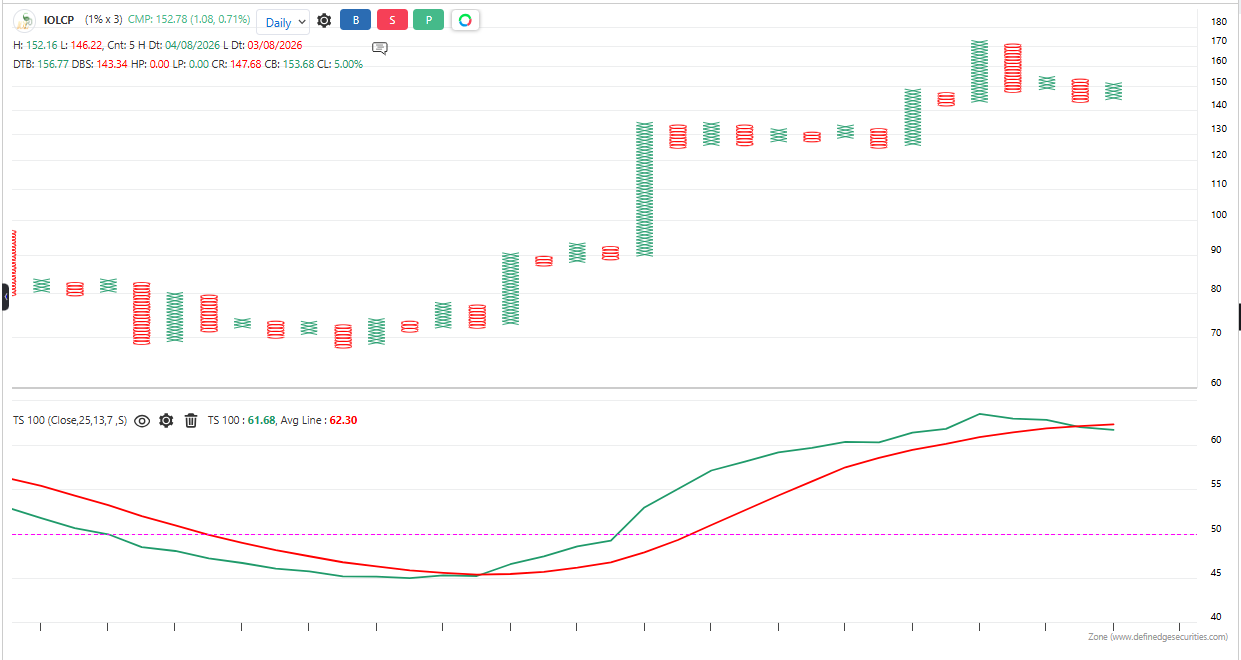
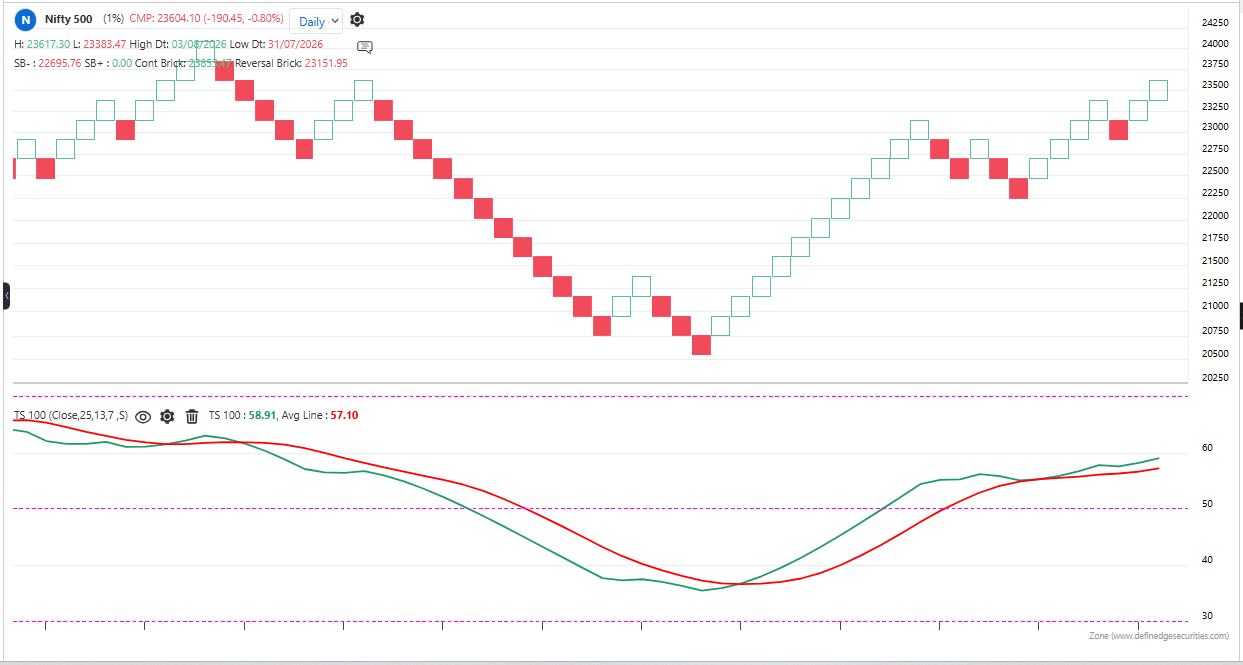
The indicator is applicable to all types of charting. Calculated based on the number of columns on P&F charts, bricks on Renko charts, lines on Line-break charts, candles on Heikin ashi charts, and lines on Kagi charts. While the formula and reading of the indicators remain the same, they become more dynamic on these charts.

Open Demat Account