Customer Support : 020-61923200, [email protected] | Call and Trade : 020-61923220

Percentage Price Oscillator (PPO)
#trend #momentum #crossover #macd-family #percentage
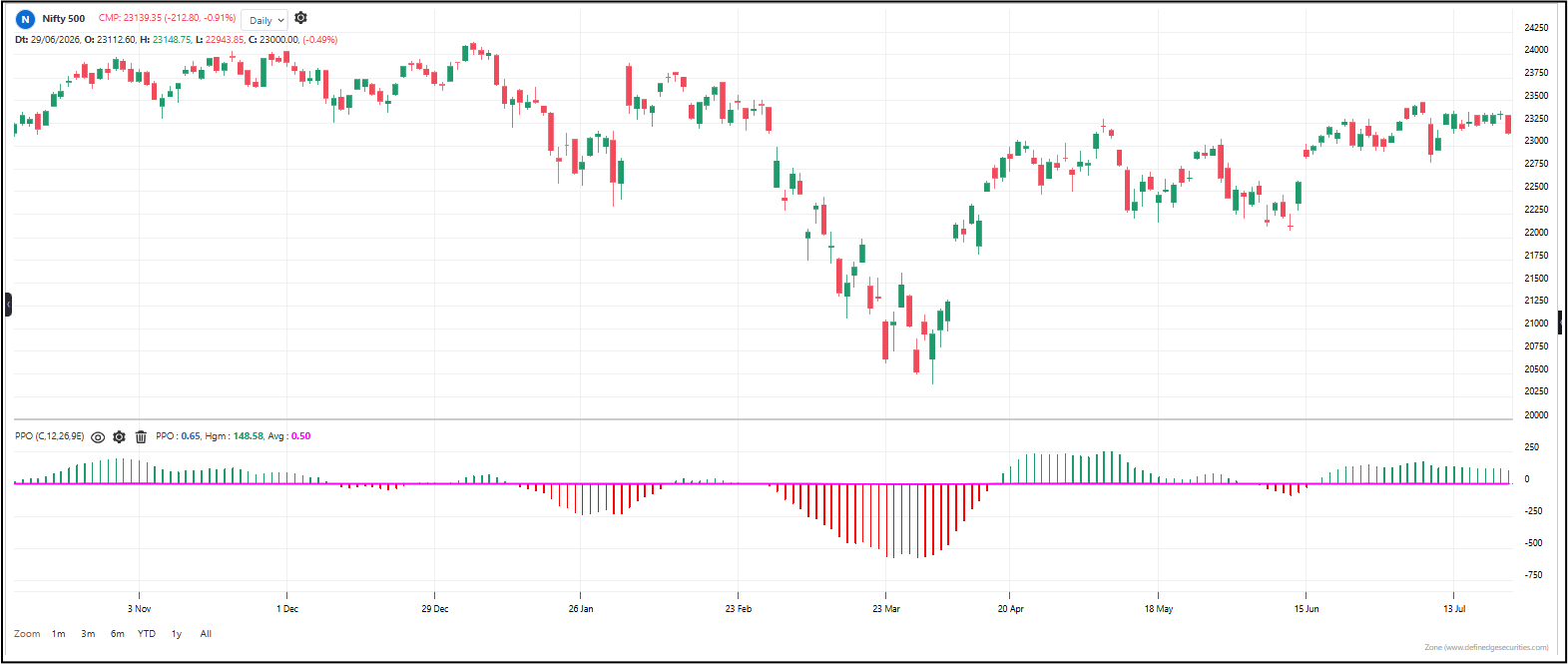
The PPO compares two moving averages of different speeds and expresses their relationship as a percentage of price. This percentage-based approach is the key difference from a standard MACD — because the PPO is a percentage, it can be compared across stocks with completely different price levels. The PPO line, its signal line, and a histogram together show trend direction, momentum strength, and potential reversals.
Default period: 12 (fast average), 26 (slow average), 9 (signal line)
Line behavior:
The PPO line moves above and below zero. When the fast average is above the slow average, the PPO is positive. When the fast average drops below the slow average, the PPO turns negative. The signal line is a smoothed version of the PPO. The histogram shows the gap between the PPO and its signal line — growing bars mean momentum is building; shrinking bars mean momentum is fading.
Useful readings:
– Above zero: Fast average is above slow average — uptrend structure
– Below zero: Fast average is below slow average — downtrend structure
– PPO crossing above signal line: Bullish momentum building
– PPO crossing below signal line: Bearish momentum building
– Histogram expanding: Momentum is strengthening in the current direction
– Histogram shrinking: Momentum is weakening — possible reversal ahead
– PPO divergence from price: Trend may be losing steam
Objective rules:
– Buy when PPO crosses above its signal line
– Sell when PPO crosses below its signal line
– Buy when PPO crosses above zero (fast average moves above slow average)
– Sell when PPO crosses below zero (fast average moves below slow average)
– Use the histogram to gauge momentum strength — fading histogram warns of exhaustion
– All standard MACD rules apply (crossovers, divergences, zero-line crosses)
What makes it unique:
Because the PPO is expressed as a percentage rather than raw points, you can compare the PPO reading of a $50 stock directly with a $5,000 stock. This makes it ideal for scanning across multiple instruments or for comparing relative strength between different assets. It behaves exactly like MACD but on a normalized scale..
The indicator table value in TradePoint & RZone also provides you with a list of all values of this indicator for any group of stocks. This will allow you to compare the readings of this indicator across different stocks.
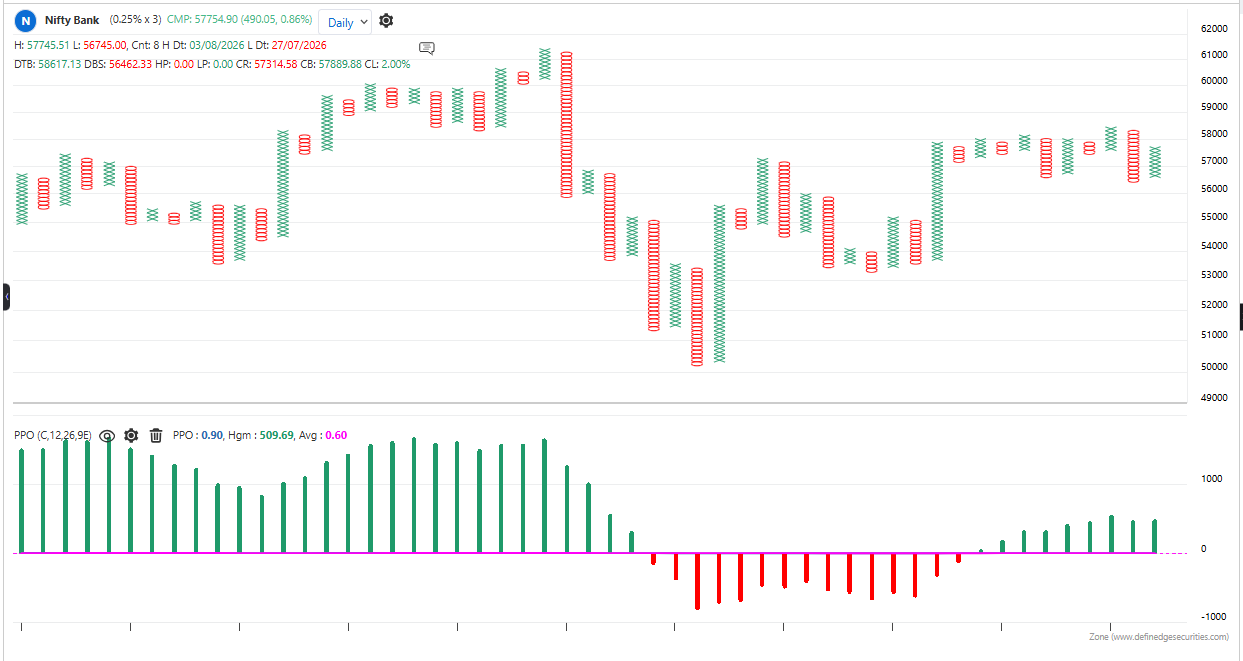
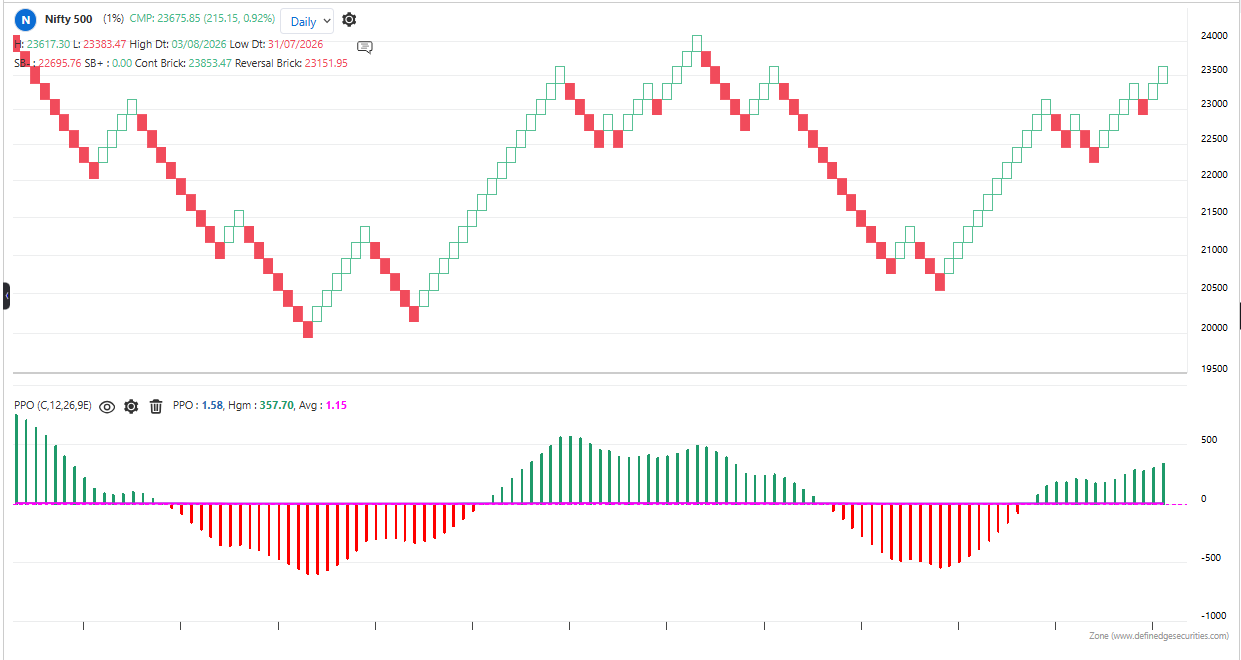
This indicator is also available in the System Builder of RZone & TradePoint for all charting methods. Using the system builder, you can develop various strategies based on the different conditions already present in this indicator. Additionally, it can be used with other indicators or price patterns to develop effective trading strategies. For any group of stocks and market segments, you can scan and backtest stocks based on those strategies.