Customer Support : 020-61923200, [email protected] | Call and Trade : 020-61923220

Rotation Factor
#volume #price #rotation #money-flow
Rotation Factor tells you whether volume and price are moving together or apart over a short rolling window. When volume rises as price rises, money is flowing in — bullish. When volume rises as price falls, money is flowing out — bearish. When volume and price disagree, the move is suspect. It’s a simple but powerful rotation signal that identifies when smart money is entering or leaving.
Period: 3
Average Period: 5
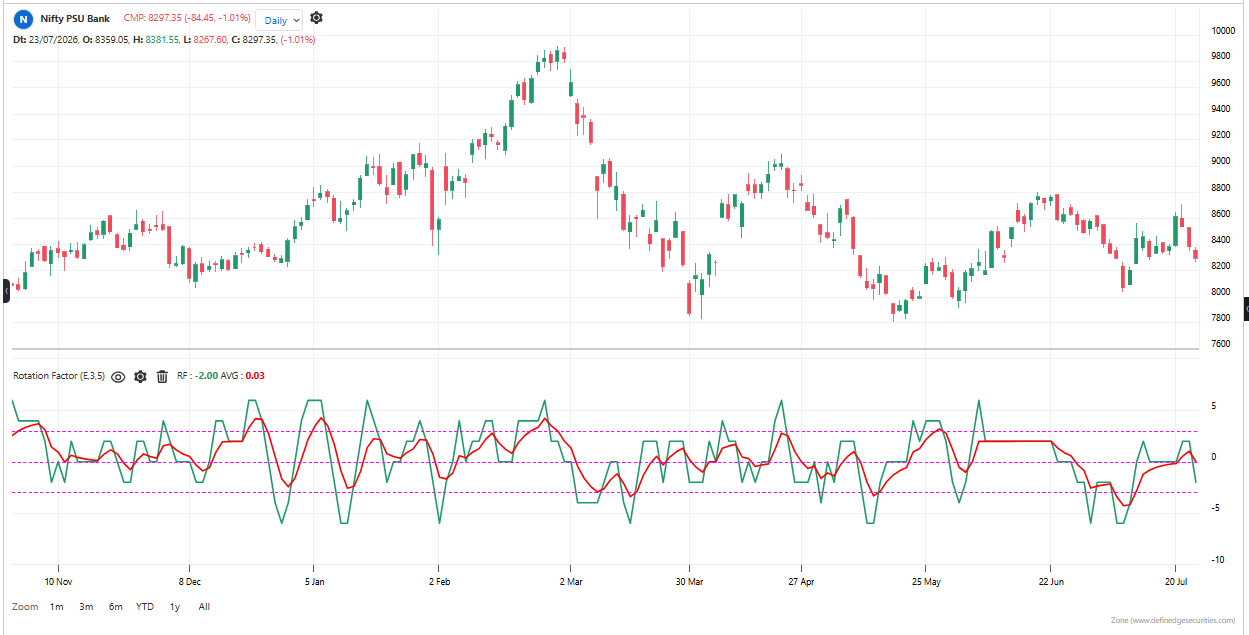
In the Rotation Factor indicator, two lines are plotted below the chart.
1 – Green line represents Rotation Factor
2 – Red line represents the Average
Rising rotation factor indicates bullish trend.
A falling Rotation Factor indicates a bearish trend.
Rotation Factor indicates a Bullish trend when it is above the zero line, while Rotation Factor indicates a Bearish trend when it is below the zero line.
How to read it:
A single line that sums up the relationship between volume direction and price direction over a 3-period window. Positive readings mean volume and price are aligned — money is flowing in the direction of the trend. Negative readings mean volume and price are diverging — money is flowing against the trend. The more extreme the reading, the stronger the alignment or divergence.
Useful readings:
– Positive and rising — volume and price are strongly aligned. Money is flowing in the direction of the trend. Very bullish.
– Positive and falling — volume and price are still aligned but weakening. The money flow is slowing.
– Negative and falling — volume and price are strongly diverging. Money is flowing against the trend. Very bearish.
– Negative and rising — volume and price are still diverging but improving. The money flow is stabilizing.
– Near zero — volume and price are neutral. No clear money flow.
– Sharp spike positive — sudden surge of money flowing in with price. Strong bullish rotation.
– Sharp spike negative — sudden surge of money flowing out against price. Strong bearish rotation.
Use cases:
– Confirming breakouts: A breakout with positive Rotation Factor is a real breakout — money is flowing in. A breakout with negative Rotation Factor is a fakeout — money is flowing out despite the price move.
– Spotting reversals: When price is rising but Rotation Factor turns negative, money is flowing out despite the price move. That’s a reversal warning.
– Rotation screening: Screen for stocks with the highest Rotation Factor — those are the ones where money is flowing in the fastest. Those are your rotation picks.
– Exit timing: When Rotation Factor turns negative during a trend, money is starting to flow out. That’s your early exit signal.
Objective rules:
– Only take long signals when Rotation Factor is positive.
– Only take short signals when Rotation Factor is negative.
– Enter when Rotation Factor spikes positive (for longs) or negative (for shorts).
– Exit when Rotation Factor crosses through zero in the opposite direction.
– Avoid trading when Rotation Factor is near zero — there’s no money flow to trade.
What makes it unique: Most volume indicators measure volume in isolation — high volume or low volume. The Rotation Factor measures volume in relationship to price. High volume means nothing if it’s happening on the wrong side of the move. The Rotation Factor sees whether volume is supporting the trend or fighting it. That’s the difference between seeing a crowd and seeing which way the crowd is moving.
The indicator table value in TradePoint & RZone also provides you with a list of all values of this indicator for any group of stocks. This will allow you to compare the readings of this indicator across different stocks.
This indicator is also available in the System Builder of RZone & TradePoint for all charting methods. Using the system builder, you can develop various strategies based on the different conditions already present in this indicator. Additionally, it can be used with other indicators or price patterns to develop effective trading strategies. For any group of stocks and market segments, you can scan and backtest stocks based on those strategies.
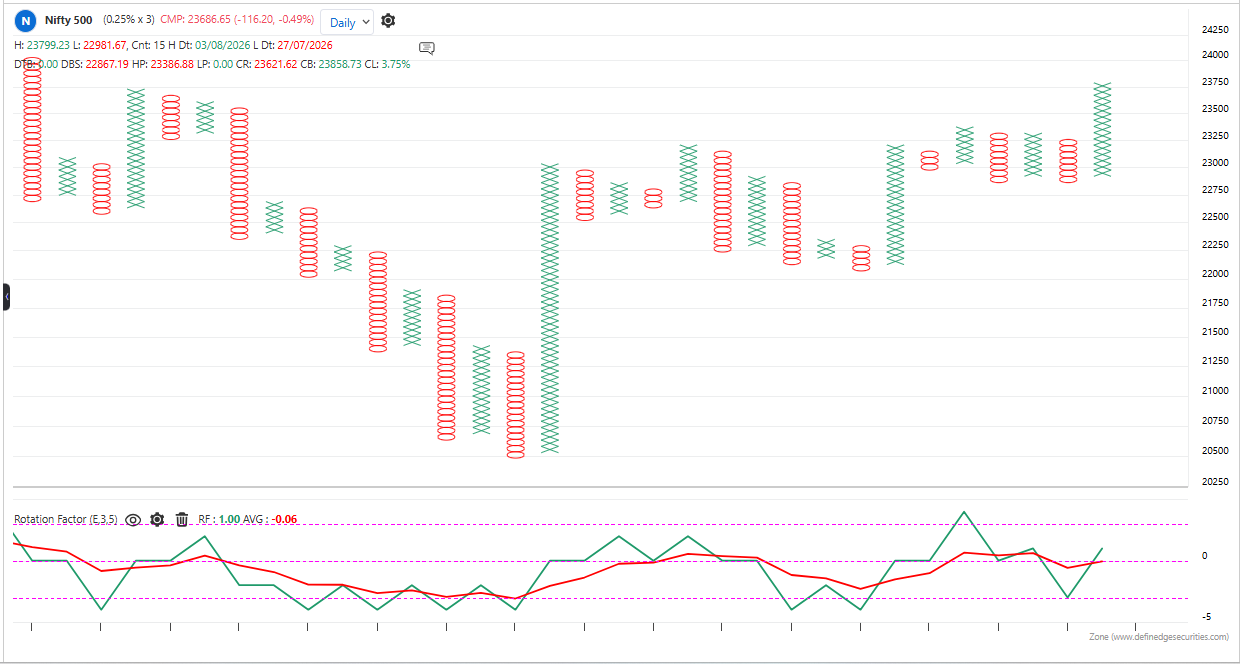
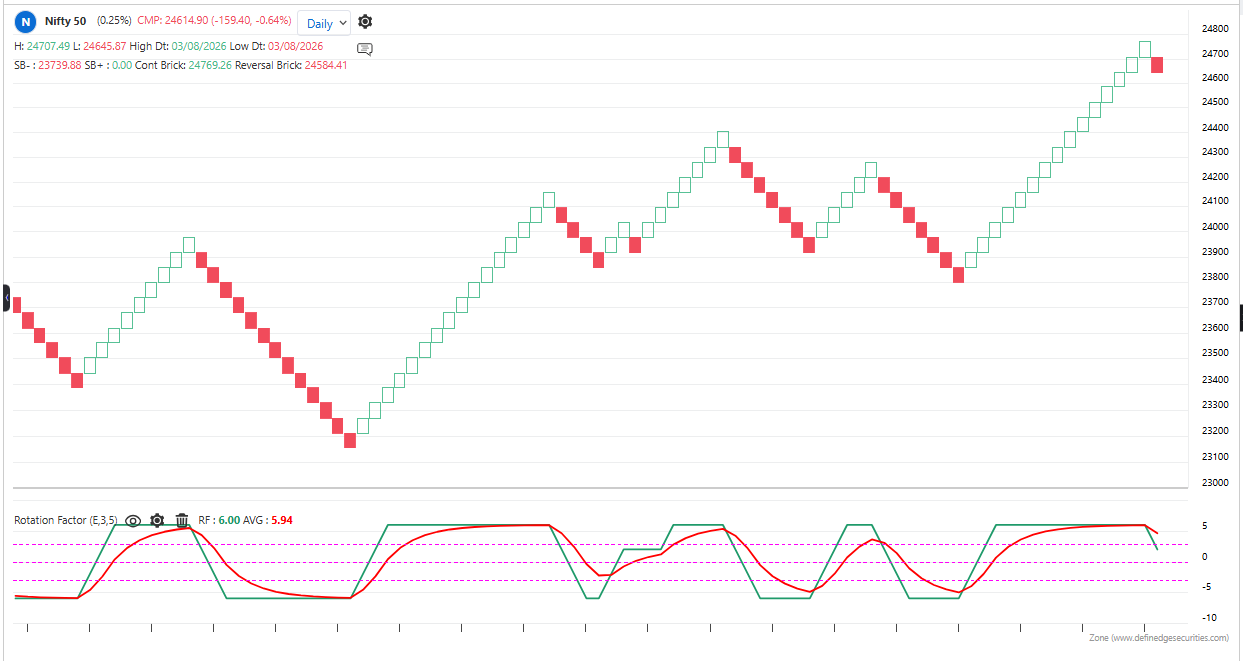
The indicator is applicable to all types of charting. Calculated based on the number of columns on P&F charts, bricks on Renko charts, lines on Line-break charts, candles on Heikin ashi charts, and lines on Kagi charts. While the formula and reading of the indicators remain the same, they become more dynamic on these charts.