Customer Support : 020-61923200, [email protected] | Call and Trade : 020-61923220

Ease of Movement
#volume #momentum
Inventor: Richard W. Arms Jr.
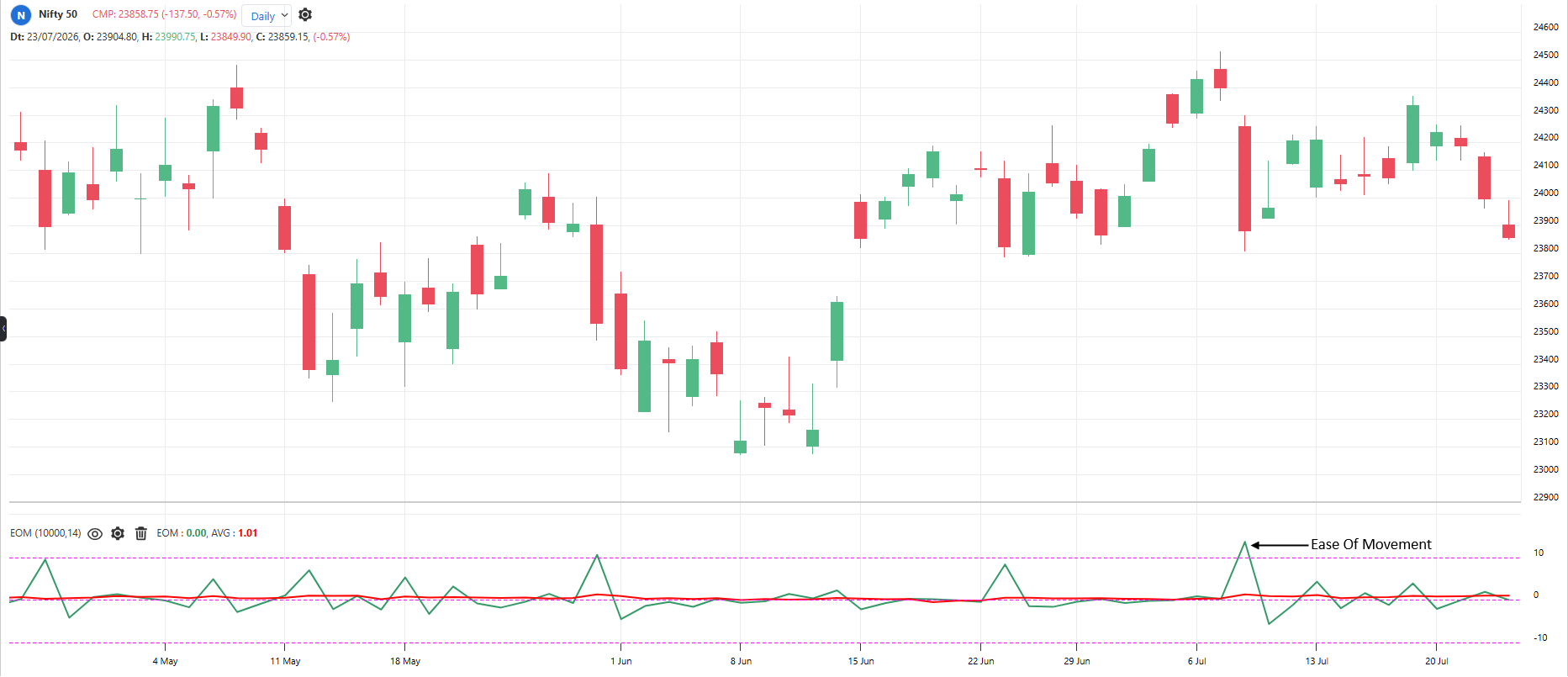
Shows how easily price is moving, by combining price change with the volume it took to move it. Price rising on small volume moves the line up strongly (easy rise). Price needing huge volume to barely move keeps the line near zero (hard grind). Usually smoothed with a 14-period average.
Default period: 14
Line above zero indicates price rising easily. Line below zero indicates price falling easily. Near zero indicates heavy, effortful movement.
Useful readings:
Above zero and rising: Price gliding up with little resistance, healthy uptrend
Below zero and falling: Price sliding down easily, healthy downtrend
Hovering near zero: Big effort, small movement, market undecided
Price rising but EOM near zero: Rally is a heavy grind, needs lots of volume, caution
Price flat but EOM positive: Quiet easy accumulation, bullish clue
Sharp EOM spike: One-sided move with no opposition
Objective rules:
Bullish: Smoothed EOM crosses above zero.
Bearish: Smoothed EOM crosses below zero.
Breakout confirmation: Take a price breakout only if EOM also turns positive (long) or negative (short)
Grind warning: Exit part of longs if price makes new highs while EOM slips back toward zero
What makes it unique:
It divides movement by the volume effort it required, exposing effortless glides and heavy grinds. No other tool measures the ease of a move rather than the move itself.
The indicator table value in TradePoint & RZone also provides you with a list of all values of this indicator for any group of stocks. This will allow you to compare the readings of this indicator across different stocks.
This indicator is also available in the System Builder of RZone & TradePoint for all charting methods. Using the system builder, you can develop various strategies based on the different conditions already present in this indicator. Additionally, it can be used with other indicators or price patterns to develop effective trading strategies. For any group of stocks and market segments, you can scan and backtest stocks based on those strategies.
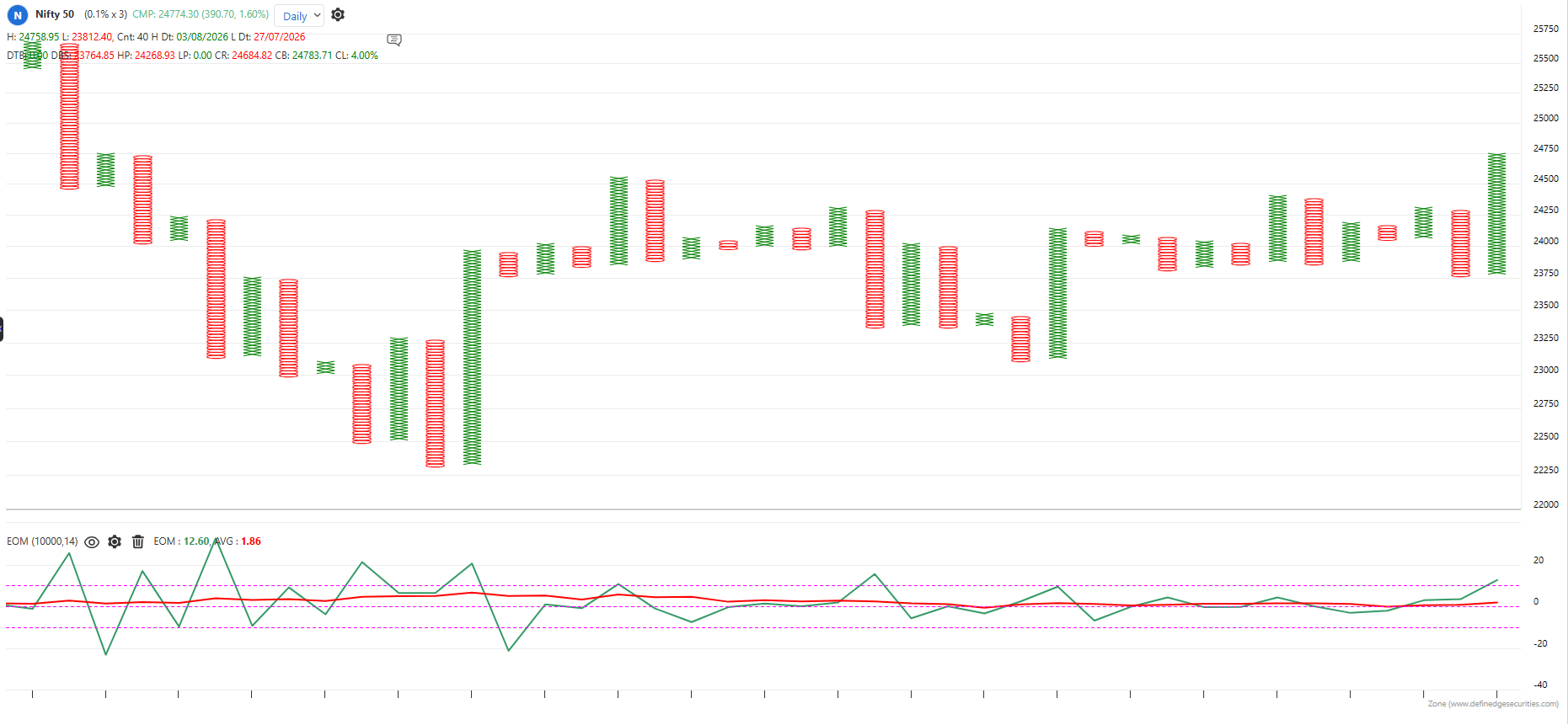
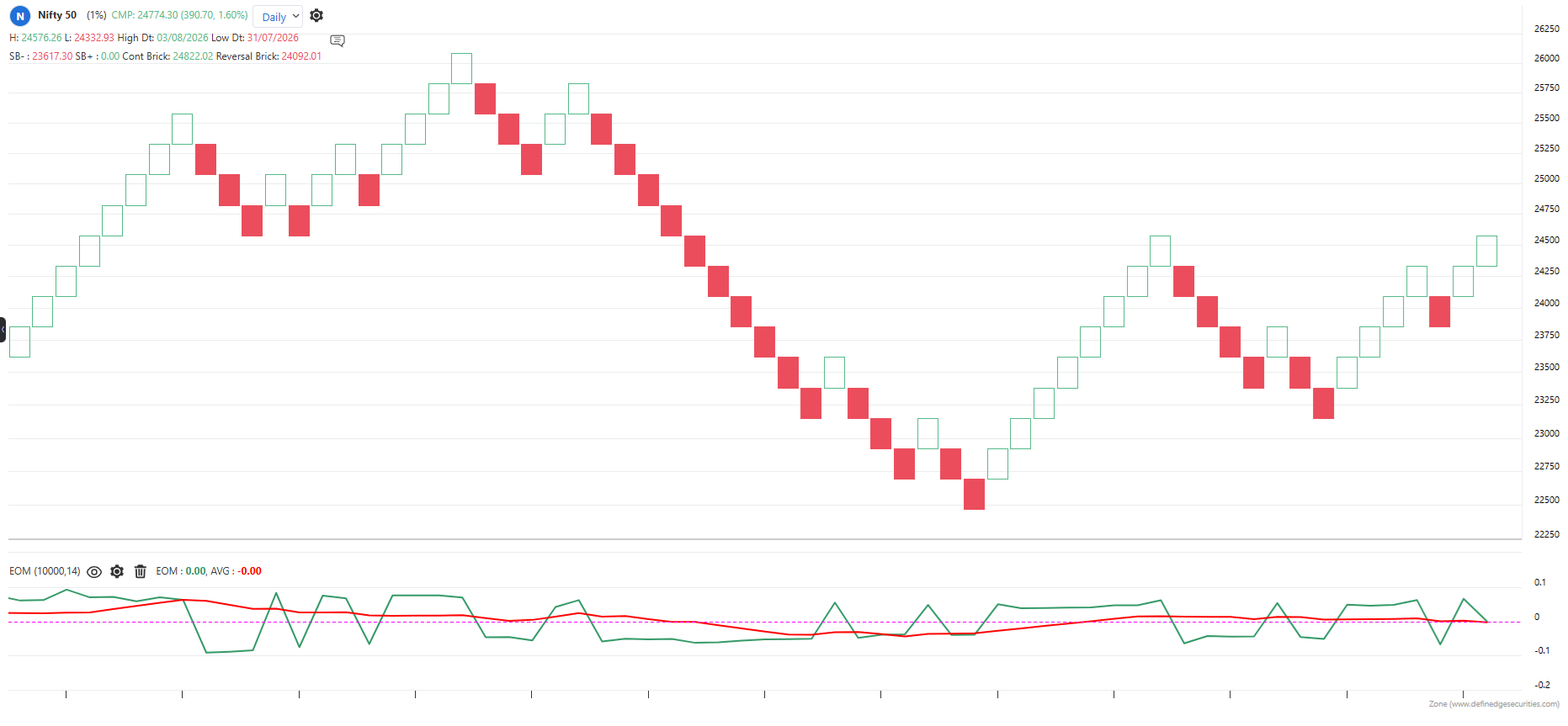 The indicator is applicable to all types of charting. Calculated based on the number of columns on P&F charts, bricks on Renko charts, lines on Line-break charts, candles on Heikin ashi charts, and lines on Kagi charts. While the formula and reading of the indicators remain the same, they become more dynamic on these charts.