Customer Support : 020-61923200, [email protected] | Call and Trade : 020-61923220

Z Score
#statistics #meanreversion #overextension
Inventor:
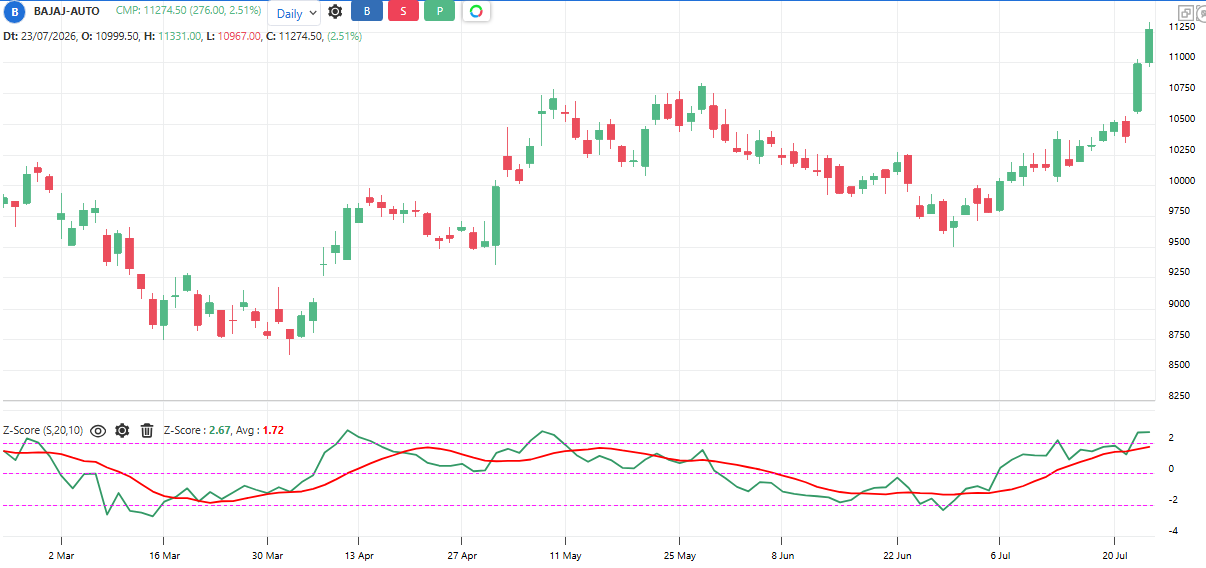
The statistician’s stretch measure: how many standard deviations price sits away from its moving average. Z = (Close – MA) / Standard Deviation. A Z of +2 means price is 2 standard deviations above average – a statistically rare stretch. It is the number behind Bollinger Bands (the bands sit at Z = +2 and -2), shown as a clean oscillator line.
Default period: 20 (MA and standard deviation)
Reading above zero indicates price above its average. Reading below zero indicates below average.
Beyond +2 or -2 marks statistically stretched territory.
Useful readings:
Z above +2: Rare upside stretch, pullback risk in a range market
Z below -2: Rare downside stretch, bounce likely in a range market
Z crossing zero: Price crossing its own average
Z stays between +1 and +2 in an uptrend: Healthy trending behavior, not a sell
Z beyond +3: Extreme event, usually climax conditions
In strong trends price can hold extreme Z for long; fade extremes only in sideways markets
Objective rules:
Bullish: Z Score crosses above zero.
Bearish: Z Score crosses below zero.
Range fade long: Z below -2 AND closes back above -2 (only in a sideways market)
Range fade short: Z above +2 AND closes back below +2 (only in a sideways market)
Trend filter: Skip fade trades when ADX is above 25
Climax rule: Z beyond +3 or -3, avoid fresh entries in the move’s direction
What makes it unique:
It translates price stretch into standard deviations, the universal statistical language of how rare is this. It is Bollinger Bands expressed as a single honest number.
The indicator table value in TradePoint & RZone also provides you with a list of all values of this indicator for any group of stocks. This will allow you to compare the readings of this indicator across different stocks.
This indicator is also available in the System Builder on RZone & TradePoint for all charting methods. Using the system builder, you can develop various strategies based on the different conditions already present in this indicator. Additionally, it can be used with other indicators or price patterns to develop effective trading strategies. For any group of stocks and market segments, you can scan and backtest stocks based on those strategies.
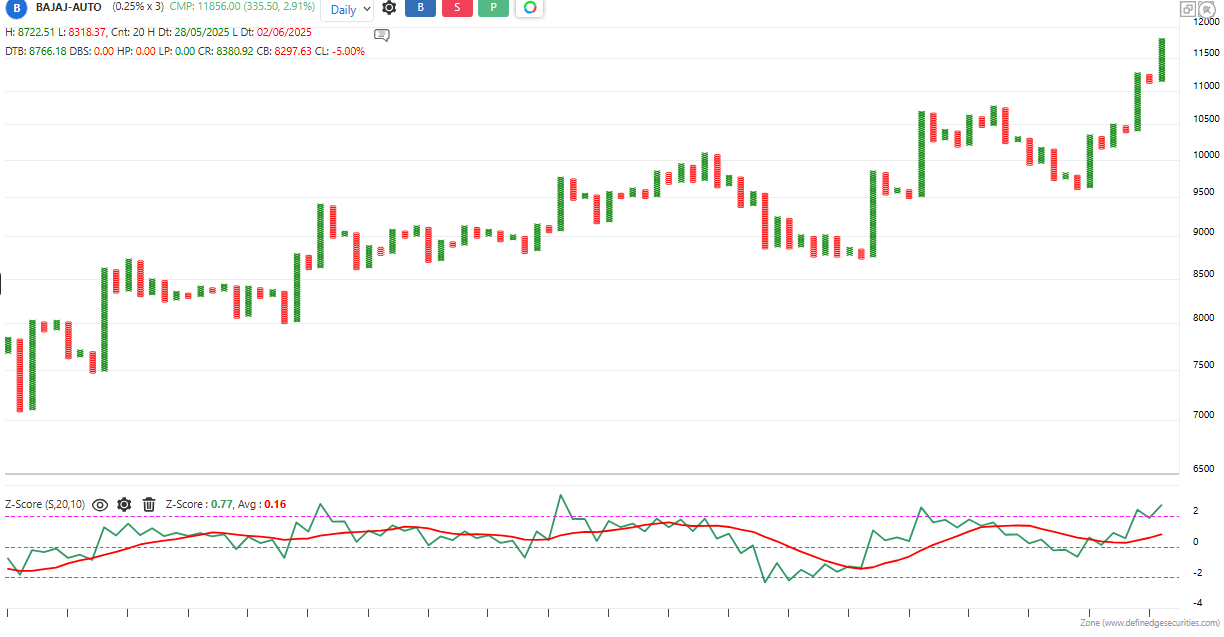
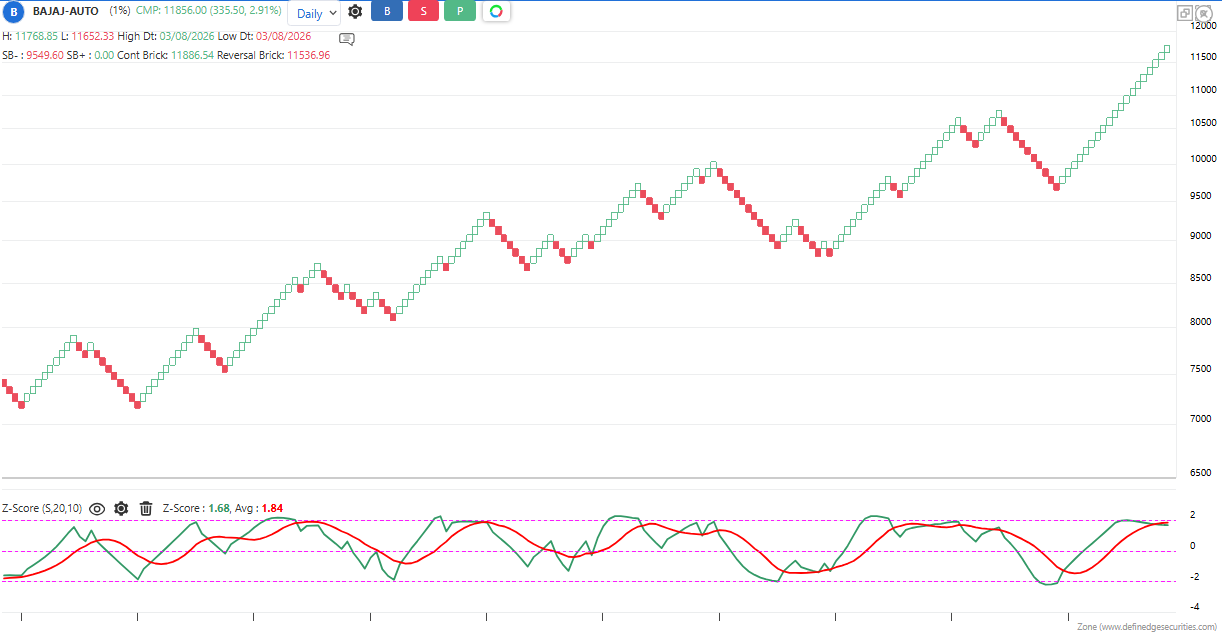
The indicator is applicable to all types of charting. It is calculated based on the number of columns on P&F charts, bricks on Renko charts, lines on Line-break charts, candles on Heikin-Ashi charts, and lines on Kagi charts. While the formula and reading of the indicators remain the same, they become more dynamic on these charts.