Customer Support : 020-61923200, [email protected] | Call and Trade : 020-61923220

The Smart Rider Bullish Option
The Smart Rider Bullish Option
Strategy Type: Intraday
Direction: Bullish
Instruments: Index Options
This is a system-based Algo on underlying instrument. You can trade in Index future, or options based on the system conditions in the underlying. You can define your own group of instruments, apply filters, decide the investment amount or quantity, and customise it as per your preference.
Noiseless charts can be extremely useful in trading across different instruments and market conditions.
Renko charts are one such category of noiseless charts.
Let me share an example of how an effective strategy can be built using them.
I realised early on that during periods of strong market momentum, simple directional strategies tend to work very well.
In fact, certain pre-determined event days such as the Union Budget often lead to heightened momentum. On such days, markets are likely to witness strong moves in either direction. Simple trend-following or directional strategies can be highly effective in capturing these moves.
During momentum phases, even trading indices like Nifty and Bank Nifty can offer meaningful opportunities.
I initially tried implementing such strategies using candlestick charts, but with limited success. When I explored noiseless charts, they immediately stood out due to their unique properties.
Renko charts, with their diagonal structure and ability to filter noise, offer significant advantages in identifying clear trends.
I have explored this in detail in my book, Profitable Trading with Renko Charts.
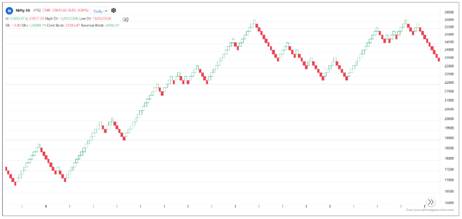
We can trade Nifty effectively using Renko charts.
All that is required is a reliable trend-following indicator on the Renko chart. At Definedge, we have developed the D Smart indicator, which was originally designed for Renko charts and later adapted for other charting methods.
It is a dynamic indicator—becoming more responsive when the trend strengthens and slowing down during sideways or volatile market conditions.
It is explained in detail in a later chapter, so I will keep it brief here.
To keep it simple:
When Nifty is above the D Smart indicator, the trend is considered bullish.
When it is below the D Smart indicator, the trend is considered bearish.
Is it really that simple?
Seemingly… yes.
But think about the underlying properties:
- You can operate on a 1-minute or even tick-level timeframe.. something not practical with traditional charts.
- Noise is filtered out, allowing you to focus on meaningful price movements.
- You get multiple bricks during trending phases, and no prints when price doesn’t move – highly efficient.
- You apply a dynamic trend-following indicator, which becomes more responsive as the trend strengthens.
- Combine the above two – when more bricks form, the indicator reacts faster, helping you ride the trend effectively.
This strategy can be applied across any instrument and timeframe.
The Rider in the strategy name stands for:
- Rule-based
- Intraday
- Directional
- Execution-driven strategy on
- Renko charts
I initially found it highly effective on event-driven days.
Over time, I realised it works just as effectively on normal market conditions as well.
Below are strategy details:
- Strategy Name: The Smart Rider Strategy
- Instrument: Nifty
- Type: Intraday
- Timeframe: 1-min
- Brick-size: 0.05%
For bullish strategy
- Action: Long
- Entry Condition: Above D Smart indicator
- Action: Enter Nifty Future
- Exit Condition: Price falls below D Smart indicator
- Action: Exit Nifty Future
This is essentially a SAR (Stop-and-Reverse) strategy.
The equity curve below, over a three-month period, provides an indication of its behaviour.
Roughly 13–15 trades can be expected per month for each strategy.
Performance is influenced by market conditions. Strong trending environments tend to deliver better results.
You may also choose to trade options based on signals generated in Nifty.
Below are strategy details:
- Strategy Name: The Smart Rider Strategy
- Instrument: Nifty
- Type: Intraday
- Timeframe: 1-min
- Brick-size: 0.05%
For bullish strategy
- Action: Long
- Entry Condition: Above Renko 40-period D Smart indicator
- Action: Enter Long CE
- Exit Condition: Price falls below D Smart indicator
- Action: Exit CE
Study it, experiment with it, and refine it to suit your trading style.
Run virtual strategies, observe their behaviour, and build conviction through experience.
You may consider reducing the indicator settings during strong trends, though this is optional.
Filters
You can further enhance the strategy by adding filters: additional rules, indicators, or pattern-based conditions.
One effective approach is to incorporate a higher timeframe trend filter, such as the daily trend of the stock.
You can also apply intraday-specific filters to improve trade quality.
With the right filters, you can further refine and personalise it to suit your trading style.
You can modify it, test it, and deploy it on the Algostra.