Customer Support : 020-61923200, [email protected] | Call and Trade : 020-61923220

Low Pole FT Strategy
Low Pole FT Strategy
Strategy Type: Intraday
Direction: Bullish
Instruments: Cash, ETF, Options
You can select the instrument type and exchange. This is a pattern-based Algo and is applicable across all instruments. You can define your own group, apply filters, decide the investment amount or quantity, and customise it as per your preference.
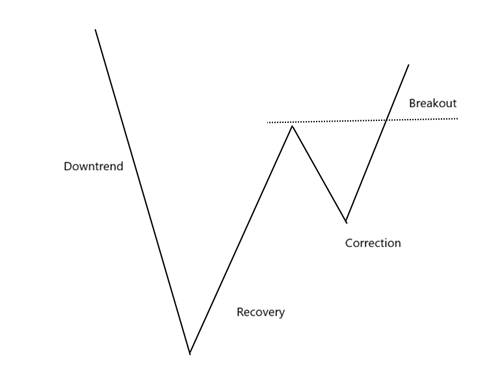
After a significant decline, certain patterns signal a potential shift in trend and are highly effective in identifying bullish opportunities.
The first sign of strength appears when price recovers sharply after the fall.
This is followed by a correction that holds above the previous major low, indicating that selling pressure is weakening.
Finally, a follow-through breakout above the recovery high confirms the emerging strength.
This sequence reflects a transition from weakness to strength. It is a bullish reversal pattern.
In Point & Figure terminology, this setup is known as a Low Pole Follow-Through pattern.
Low Pole:
Strategy Details:
- Strategy Name: Low Pole FT Strategy
- Universe: F&O Stocks (Cash segment)
- Action: Long
- Type: Intraday
- Max Open Position: 10
- Max Trades in a day: 20
- Max Day loss limit: 15,000 (User-preference and depending upon quantity)
- Square off time: 3.10 pm
- Box-size: 0.25% x 3 (High-low chart)
- Timeframe: 1-min
- Entry Condition: Low Pole Follow-through Pattern
- Exit Condition: Bearish Swing breakout (Double bottom sell)
- Market Trend Filter: Nifty intraday trend should be bullish. Nifty (0.05% x 3) above 10-SMA on one-min timeframe
Market Trend Filter
An intraday market trend filter is one of the most effective ways to improve strategy performance.
Even a strong bullish breakout strategy can struggle on days with a weak or sideways trend.
This often leads to failed breakouts and higher drawdowns.
To address this, trades can be aligned with the broader market trend.
- Execute bullish strategies only in an uptrend
- Execute bearish strategies only in a downtrend
We refer to this as the Market Trend Filter.
How It Works
If the Nifty is in a bullish trend, only bullish strategies are executed.
Bullish signals are ignored when the market is not supportive.
If the market turns bearish while holding bullish positions:
- Exit existing trades based on the exit conditions
- Avoid initiating new bullish trades
In this strategy, we have applied MTF on Nifty. The strategy will run only if Nifty is bullish.
This defines a bullish market condition.
You may use any alternative method—different charting techniques, indicators, or rules—to define market direction.
The same concept can also be applied using other indices or instruments, not just Nifty.
Filters
You can further enhance the strategy by adding filters: additional rules, indicators, or pattern-based conditions.
One effective approach is to incorporate a higher timeframe trend filter, such as the daily trend of the stock.
You can also apply intraday-specific filters to improve trade quality.
You can also modify the Max Open and Max Trades parameters. Increasing these values will result in a higher average number of trades. Change the max day loss figure accordingly.
The universe considered here is the F&O segment, as an example. You can apply this strategy in cash segment as well.
This strategy can be applied across stocks, futures, options, ETFs, and commodities—whether trading a single instrument or a group of stocks.
You can identify the pattern and trade the underlying instrument such as stocks, futures, ETFs, or commodities. Alternatively, you may trade options based on signals from the underlying.
For example, when the pattern is confirmed in the underlying, you may choose to trade the corresponding ATM call option.
You can also identify and trade patterns directly on options charts, wherever applicable.
This is a simple yet effective consolidation breakout strategy.
With the right filters, you can further refine and personalise it to suit your trading style.
You can modify it, test it, and deploy it on the Algostra.