Customer Support : 020-61923200, [email protected] | Call and Trade : 020-61923220

Smart Turtle Strategy Bull
Smart Turtle Strategy Bull
Strategy Type: Positional
Direction: Bullish
Instruments: Futures, Cash, ETF, Options
You can select the instrument type and exchange. This is a system-based Algo and is applicable across all instruments. You can define your own group, apply filters, decide the investment amount or quantity, and customise it as per your preference.
There is one such pattern—defined using multiple swings, which are clearly visible on Point & Figure charts.
See below image.
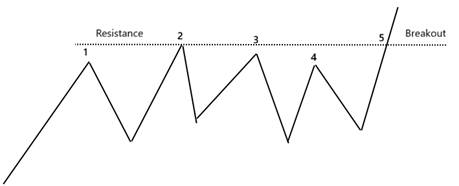
Price breaks above the highest high of the last five swings, marking a significant breakout through a strong resistance zone.
This is conceptually similar to the traditional Turtle Breakout strategy, where a bullish signal is generated when price moves above the highest high of the last 20 candles. While the original Turtle Trading system, developed by Richard Dennis and William Eckhardt, includes additional rules, that is a separate discussion.
The key difference here is the use of swing-based highs instead of time-based highs. This approach filters out minor or narrow sessions and focuses on meaningful price structures.
As a result, this setup becomes particularly effective on Point & Figure charts.
I have explained this formation in detail in my book Trade the Markets the Point & Figure Way, where I refer to it as the P&F Turtle Breakout pattern.
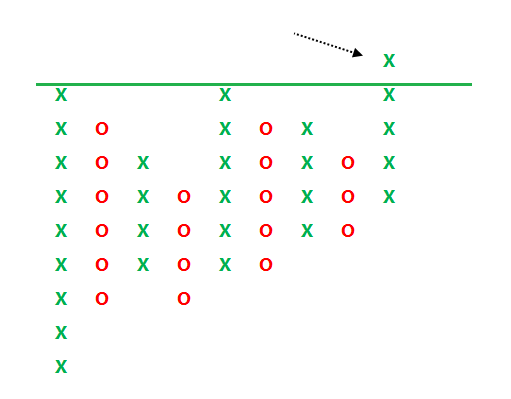
This can become a very effective pattern to identify trades on stocks, futures, or options based on signal in underlying.
This pattern shows accumulation and horizontal trend breakout. The price trend can be filtered using D Smart indicator. If the breakout occurs above the D Smart indicator, it is a significant setup.
Below is a positional strategy of entering into the stocks if
Strategy Details:
- Strategy Name: Smart Turtle Strategy
- Universe: All Futures – Near month / Cash / ETF / Underlying-based Options
- Action: Long
- Type: Positional
- Max Open Position: 6
- Max Day loss limit: 50,000 (Futures)
- Box-size: 0.25% x 3
- Timeframe: 1-min
- Entry Condition: Turtle breakout pattern above D Smart
- Exit Condition: Price falling below D Smart indicator
- Market Trend Filter: Nifty intraday trend should be bullish. Nifty (0.05% x 3) above 10-SMA on one-min timeframe
Filters
You can further enhance the strategy by adding filters: additional rules, indicators, or pattern-based conditions.
One effective approach is to incorporate a higher timeframe trend filter, such as the daily trend of the stock.
You can also apply intraday-specific filters to improve trade quality.
You can also modify the Max Open and Max Trades parameters. Increasing these values will result in a higher average number of trades. Change the max day loss figure accordingly.
The universe considered here is the F&O segment, as an example. You can apply this strategy in cash segment as well.
This strategy can be applied across stocks, futures, options, ETFs, and commodities—whether trading a single instrument or a group of stocks.
You can identify the pattern and trade the underlying instrument such as stocks, futures, ETFs, or commodities. Alternatively, you may trade options based on signals from the underlying.
For example, when the pattern is confirmed in the underlying, you may choose to trade the corresponding ATM call option.
You can also identify and trade patterns directly on options charts, wherever applicable.
This is a simple yet effective consolidation breakout strategy.
With the right filters, you can further refine and personalise it to suit your trading style.
You can modify it, test it, and deploy it on the Algostra.