Customer Support : 020-61923200, [email protected] | Call and Trade : 020-61923220

DAM Strategy – Bullish
DAM Strategy – Bullish
Strategy Type: Positional
Direction: Bullsih
Instruments: Futures, Cash, ETF, Options
You can select the instrument type and exchange. This is a system-based Algo and is applicable across all instruments. You can define your own group, apply filters, decide the investment amount or quantity, and customise it as per your preference.
The DAM strategy weaves together D-Smart Cloud, ADX, and MACD, all working in concert with Heikin-Ashi candles. This creates a structured approach, a trading model that brings together trend, strength, and timing. Built for flexibility, it’s an excellent candidate for automation, particularly on platforms like Algostra by Definedge.
The DAM strategy fundamentally alters the interpretation of price. Instead of using traditional candlestick data, this method employs Heikin-Ashi candles. These candles smooth out price movements and reduce market noise. This smoothing process creates a more stable dataset for indicators, which helps to reduce false signals and improve the reliability of trend identification.
Feeding Heikin-Ashi values into the D-Smart Cloud, ADX, and MACD components keeps the analysis and execution aligned.
Most traders in the Indian F&O space don’t fail because of strategy, they fail because of execution. They jump between indicators, override signals, and second-guess setups. The DAM strategy is built to eliminate exactly that. It’s not just a strategy, it’s a process you can execute, repeat, and most importantly, automate on Algostra.
Step 1: Start with a Bias (Don’t Trade Blind)
Before you even look at indicators, narrow your battlefield.
Scan only F&O stocks:
- Near 52-week highs (within 10%) → Look for longs
- Near 52-week lows (within 10%) → Look for shorts
It’s your edge. Why?
Because strong stocks tend to get stronger, and weak stocks tend to get weaker. You are aligning with momentum.
Step 2: Define the Trend (No Trend = No Trade)
Now bring in the D-Smart Cloud.
- Price above cloud → Bullish trend
- Price below cloud → Bearish trend
Simple rule:
If the cloud doesn’t agree with your bias, skip the trade. No negotiation. This one filter alone will save you from a majority of bad trades. Most losses come from trading against the structure.
Step 3: Check Strength (Avoid Dead Markets)
Here’s where most traders get trapped—sideways markets.
Enter ADX:
- ADX > 20 → Momentum is Alive
- ADX ≤ 20 → Momentum is Dull
Think of ADX as your market permission slip. Even if everything looks perfect, if ADX is low, you are trading in a dull market. And dull markets kill momentum strategies.
Bonus insight:
- Rising ADX = Trend gaining power
- Falling ADX = Trend losing steam
Step 4: Time the Entry (Precision Matters)
Now comes the trigger: Moving Average Convergence Divergence (MACD)
MACD Above Signal Line → Buy
MACD Line Below Signal Line → Sell
But here’s the catch most people miss:
They consider MACD signals in the direction of the trend. That’s what makes DAM powerful.
The Flow You Must Follow (Non-Negotiable)
This is your checklist. Burn it into your process:
Trend → Strength → Timing
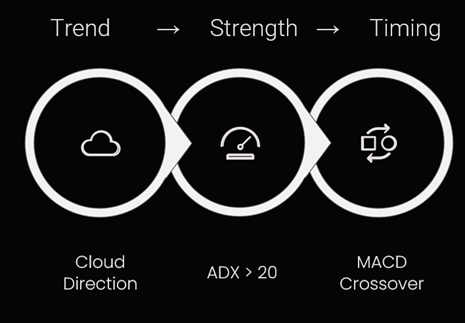
1. D-Smart Cloud confirms direction
2. ADX confirms strength
3. MACD confirms entry
If even one is missing, you do nothing. No exceptions. That’s how discipline is built.
Entry & Exit Rules (Keep It Mechanical)
Long Entry Rules:
- Cloud: Bullish
- ADX: Above 20
- MACD: MACD Line Above Signal Line
Long Exit Rules:
MACD turns Bearish (crossover)
Example of Long Entry and Exit:
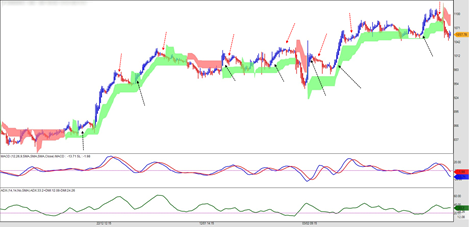
No guesswork. No “let me hold a little longer (hope).”
Where Most Traders Mess This Up
Let’s be honest:
- They take MACD signals without trend
- They ignore ADX because “setup looks good”
- They trade random stocks instead of high-probability ones
- They hesitate on entries and delay exits
That’s exactly what this system is designed to fix.
Make It Work on Algostra (This Is the Real Edge)
This strategy becomes powerful when you stop executing it manually. On Algostra, you can:
Now think about this:
- No hesitation.
- No emotional exits.
- No missed trades.
That’s the difference between knowing a strategy and running a system.
The Real Mindset Shift
This is where it gets serious. The DAM strategy is about filtering better trades. You will take fewer trades. You will skip a lot. You will feel like you are missing out.
Because what you are really doing is:
- Avoiding noise
- Avoiding weak trends
- Avoiding emotional decisions
And that’s where consistency is built.
Filters
You can further enhance the strategy by adding filters: additional rules, indicators, or pattern-based conditions.
One effective approach is to incorporate a higher timeframe trend filter, such as the daily trend of the stock.
You can also apply intraday-specific filters to improve trade quality.
With the right filters, you can further refine and personalise it to suit your trading style.
You can modify it, test it, and deploy it on the Algostra.