Published on: October 23, 2025

Wishing you and your family a very Happy Diwali 2025 and a Prosperous Vikram Samvat 2082!
May this festival of lights bring happiness, success, and harmony to your life.
On behalf of the entire Definedge family, I extend our heartfelt gratitude for your continued trust and support. Your faith in us has been a vital part of our journey to empower traders and investors through knowledge, innovation, and technology.
Diwali Picks – A Tradition with a Thought
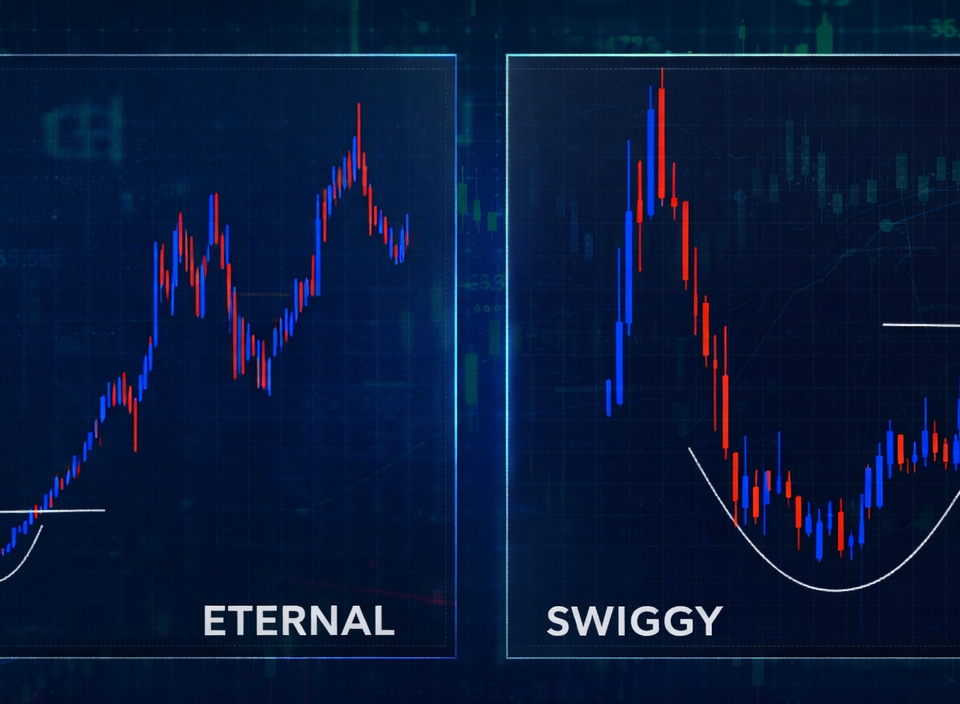
It has become a tradition to share Diwali picks for Muhurat Trading. You will find many such lists from brokers and advisors—and even combined images floating on social media.
But have you ever wondered what to do after buying these Diwali picks?
Do you hold them long-term? Till next Diwali? Do you follow the suggested stop-loss and targets? In most cases, it ends up being a matter of judgement.
We are not against the tradition, but Diwali picks are like any other stock ideas shared throughout the year. Diwali doesn’t make them special. Investing in quality stocks should be a regular, disciplined process.
So, this Diwali, let’s make it special by learning methods that stay with us permanently. As we have done in our past newsletters, let’s talk about ideas and systems that can guide us all year round.
Investing & Trading
Let’s start with a simple way to look at trading and investing.
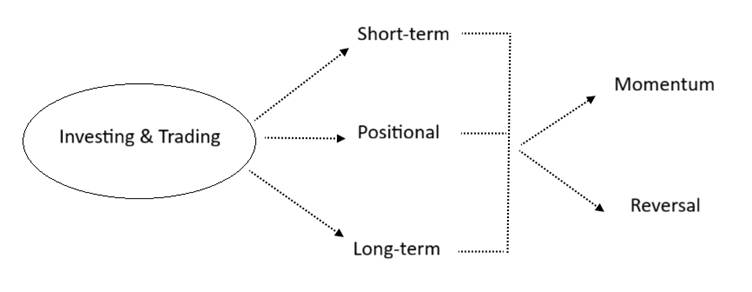
There are three time horizons:
- Short-term – Intraday or very short-term trades
- Positional – Medium-term or Swing trading
- Long-term – Holding for several months or years
Across these horizons, there are mainly two broad approaches:
- Momentum: Investing in stocks already in an uptrend, expecting them to continue rising.
- Reversal: Investing in stocks that are falling or consolidating, expecting them to turn around.
A pullback (temporary correction) within an uptrend is also a part of the momentum method. So, essentially, all strategies fit into either Momentum or Reversal.
Process
A well-defined process is the key to success in both trading and investing.
A good process answers four basic questions:
- What to buy
- When to buy
- How much to buy
- When to exit
It should include your method, position sizing, risk management, and how you adapt to different market phases.
Judgment is fine—but remember, judgment cannot be backtested. Try to make your system as objective as possible.
Long-term Investing
Long-term portfolios are built by investing in quality stocks and holding them for years. These portfolios could include growth stocks or value stocks (reversal type).
You should continue with your such type of portfolios. We at Definedge recommend another approach – Invest in Momentum, not stocks.
Our platform Momentify offers a complete setup for momentum investing. There is no platform fee and no brokerage on investments made through Momentify.
Momentum investing is a proven and scientific approach. The Learn section in the platform explains it in detail.
We suggest three types of Momentify investing portfolios:
- ETF Portfolio
- Small & Midcap Portfolio
- Large Cap Portfolio
If you want two portfolios, you can combine Nifty 500 (or BSE 500) with ETFs. If you prefer higher risk, consider adding a Microcap portfolio.
Benchmark Strategy
Strategy Name: MI Strategy (MIP-12)
Universe: Nifty 500
Market Trend Filter: Nifty 500 – 20 EMA
Performance Period: 252
Retracement: 50% from 52-week high
Trend Filter: 200 EMA
Relative Momentum: Ratio 200 EMA
Allocation: Reinvestment
Ranking Criteria: Volar
Rebalance: Monthly
Number of Stocks: 20
Exit Rank: 40
This strategy (MIP-12) is available under Sample Strategies in Momentify.
You can backtest it using the RZone platform before applying it live.
Tweaks for Different Universes
Small–Mid–Microcap Portfolio
Use Tadka strategy or noiseless charts for smoother returns and lower drawdowns.
Monthly rebalance is ideal. Stop-loss is no-harm.
Large Cap Portfolio
Tighten the retracement and trend filter settings.
Monthly rebalance is good; weekly works too.
Stop-loss is not required, rebalance is a better option.
Portfolio of 5–7 stocks is sufficient.
ETF Portfolio
Use All-ONE ETFs (Domestic) or All-ONE ETFs group.
Tadka strategy can help improve returns.
Market filter is optional.
Rebalance monthly or weekly.
Stop-loss is not required, rebalance is a better option.
Portfolio of 5–7 ETFs recommended.
Check above category strategy samples in the sample strategy segment of Momentify.
Momentum investing is a long-term approach. Focus on the process, not individual stocks.
Backtest to build conviction. Outperformance comes when you stay invested for 3–5 years or more.
Trading
Trading is a different approach altogether.
Here, you track and act more frequently, following clear rules for entry, exit, position sizing, and risk management.
We’ll discuss Intraday, Options, and very short-term trading separately when we launch our Algo platform.
For now, let’s focus on positional or swing trading.
Key Tools and Factors
- Price
- Indicators
- Volume
- Relative Strength
- Breadth
- Noiseless Charts
- Matrix & Performance Tables
- Popular Trading Strategies
- Multi-Timeframe Scanners
All these are available in the RZone platform. Choose the studies you understand best. For example, a stock may turn bullish when multiple indicators across different timeframes align and it shows a significant increase in volume.
Below are a couple of trading systems based on price patterns.
Multi-Breakout Trading System
P&F (Point & Figure) charts are powerful for identifying price breakouts.
A Multi-breakout pattern on higher box-values such as 3% box value is highly effective for spotting stocks breaking out of accumulation zones.
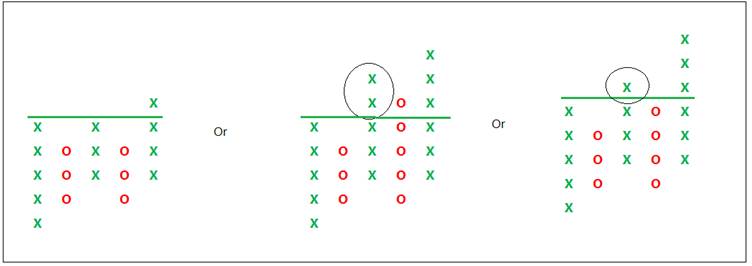
How if we design a process to trade this pattern systematically?
System Setup:
- Universe: Nifty 500 (or your choice)
- Entry: Multi-column breakout (3% box value)
- Exit: Double bottom sell or High Pole
- Qualifier: Stocks within 80% of 52-week high
When you run the scanner, you will find multiple stocks that qualify for this pattern. Use the Momentum ranking method to filter them — Volar is an excellent ranking system for this purpose.
Rank the shortlisted stocks based on Volar.
Keep no more than five stocks in the portfolio at a time — even fewer is perfectly fine. Once a stock qualifies, continue holding it unless a bearish pattern is triggered.
You can backtest this setup in RZone → Momentum Trading Backtesting.
Experiment with tweaks and try to improve the results. You may also use the Turtle Breakout method instead of Multi-breakout if you wish to create multiple portfolios.
Additionally, you can apply Relative Strength, Breadth, or Market Trend Filters to refine the system — that part is up to you.
This trading system can be easily designed in Momentify, and you will find a sample strategy for it in the Momentify Trading section.
This system helps you identify strong momentum stocks breaking out from consolidation zones.
By ranking with Volar and keeping a small, focused portfolio, you can capture trending moves while controlling risk.
It’s systematic, backtestable, and easy to automate in Momentify.
Super breakout Trading System
Super pattern is an extremely useful and time-tested momentum pattern.
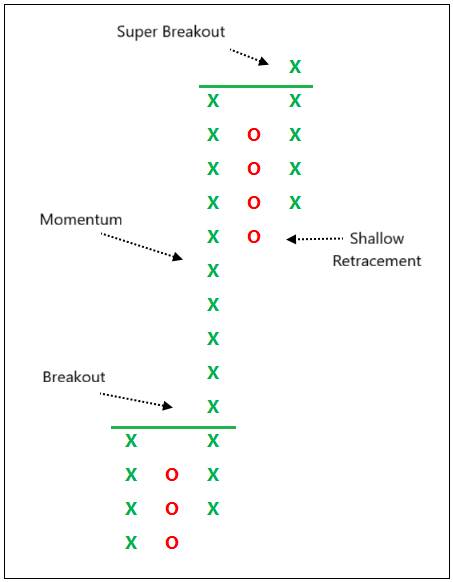
- Universe: Nifty 500 or your choice
- Entry pattern: Super Pattern
- Box-value: 1%
- Exit pattern: Double bottom sell or High Pole
- Qualifier: Stocks within 80% from 52-week high
- Ranking: Volar
- Max stocks in portfolio: 5 or less
Back test in RZone. Apply tweaks. You will find this sample strategy in Momentify.
The Super Breakout pattern identifies high-momentum stocks ready for strong price moves.
It’s a simple yet powerful method using Point & Figure charts with the Volar ranking to focus on top performers.
Ideal for traders who prefer clear, objective breakout setups that can be easily tested and executed in Momentify.
Fusion Breakouts
As explained earlier, you can pick any study in RZone that you understand well and use it to create your own strategy.
Here is one such example.
The P&F Fusion Matrix is a comprehensive scoring table that combines price action and relative strength. Stocks with a total performance score above 7 in the Fusion Matrix are considered bullish.
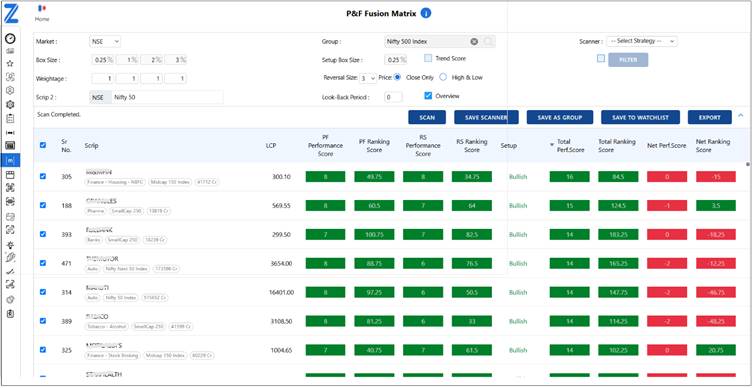
How about creating a trading portfolio based on this table?
Your entry pattern could be any P&F-based pattern or another trading setup of your choice.
Below are the steps to create a Momentify trading portfolio using the Fusion Matrix table:
- Go to P&F Fusion Matrix in RZone. Click Filter, set the condition “total ranking score above 7,” and save the strategy as (A).
- Go to Price Scanner → Point & Figure Scanner, select your preferred pattern (for example, Bullish AFT, IFT, or Turtle Breakout from the Popular segment), and save it as (B).
- Go to Unusual Volume Scanner, select your group, and save it as (C). This scanner identifies stocks trading with more than 100% of their 20-day average volume.
- Open Master Scanner, select the scanner names and strategies A, B, and C, and save the combined strategy.
- Finally, go to the Momentify Trading Section, select the RZone scanner, and save the strategy.
Define your total allocation amount, number of stocks, and ranking method in your Momentify trading strategy.
The Fusion Breakout method combines price action and relative strength for strong confirmation.
It filters stocks with a Fusion Matrix score above 7, supported by breakout and volume signals.
This approach helps you identify technically strong and momentum-aligned stocks, fully configurable in Momentify.
Momentify – Your Process Partner
Whether for investing or trading, you can define your portfolio amount, size, market trend filter, entry, and exit rules in Momentify.
For Investing:
You will receive an email notification on your rebalance date. The system will automatically create your basket based on your defined strategy — you just need to click ‘Execute’ to rebalance your portfolio.
For Trading:
At your chosen time (say, 3 PM), go to the Momentify Basket and click ‘Scan’. The platform will display stocks and quantities as per your strategy. Simply select and execute the trades.
When any stock in your portfolio hits its exit condition, you will get a notification.
Stick to your scan time and follow your process consistently — that’s the key to disciplined trading and investing.
Discipline and consistency turn a good strategy into a great one.
Set your scan time, follow it regularly, and let Momentify handle the process — so you stay systematic, not emotional.
Summary & Takeaway
Process is the key to success. Every successful trader and investor will agree with this.
The methods may differ, but what matters is having a well-defined process.
You have seen how strategies can be created systematically using RZone and Momentify. You may come across new ideas on social media or in books — try recreating them in a structured way through these platforms. Add your own touch, make small tweaks, test them, and see what works best for you.
When you build your own strategy, it gives you conviction — and conviction helps you stay disciplined.
Every strategy goes through periods of drawdown. It is your understanding and belief in your process that helps you remain consistent during those times.
Those who stay disciplined even in unfavourable phases are the ones who achieve real success in this business.
We will talk about Intraday Trading and Shorting in upcoming editions.
The purpose here was to show how you can simplify your trading and investing by becoming a process-oriented trader — and ultimately, your own fund manager.