Published on: January 20, 2026

If you’ve been following the news lately, you may have noticed some dramatic headlines. The US has stepped into Venezuela, its oil sector could be “restructured,” and global energy markets are paying close attention.
At first glance, this feels like one of those developments that should rattle oil prices everywhere. After all, Venezuela has the largest oil reserves in the world, even more than Saudi Arabia and more than any other country.
So a natural question follows.What does this mean for India? Is this something to be concerned about, or is the impact likely to be limited?
The short answer is neither, at least for now. The longer answer, however, is where things begin to get interesting.
Let’s break it down.
First things first: does this affect India today?
Not really. Despite all the noise, Venezuela barely matters to India’s oil imports today.
A decade ago, the situation looked very different. In 2013, India imported close to $13 billion worth of Venezuelan crude, which was a meaningful figure at the time. Venezuelan oil formed a noticeable share of our overall import basket.
That changed in 2019, when the US imposed sanctions. Almost overnight, the tap was effectively turned off. Indian refiners began pulling back to avoid secondary sanctions, payments became difficult, shipping arrangements grew complicated, insurance cover dried up and Venezuelan crude gradually vanished from Indian ports.
By 2024, India was importing only about $255 million worth of oil from Venezuela which was roughly 0.3% of our total oil imports. To put differently, even if Venezuelan oil were to disappear entirely tomorrow, India’s energy security would barely register the shock.
That is why most analysts describe the immediate impact as “minimal.”
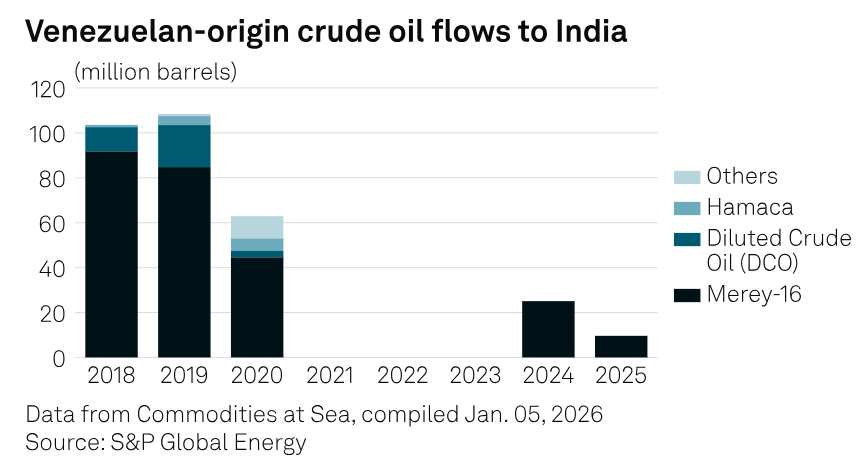
The chart captures the story more clearly than words alone. Imports peaked around 2019, collapsed soon after and never truly recovered.
So if the present-day impact is negligible, why is Venezuela still drawing so much attention?
Because Venezuela is oil’s biggest paradox
Here’s the strange thing. Venezuela has more oil underground than any other country on Earth.
It holds roughly 303 billion barrels of proven reserves which are about 17% of the world’s total. A large share of this oil lies in a region known as the Orinoco Oil Belt, where the ground is so rich in hydrocarbons that extraction should, in theory, be straightforward.
And yet, Venezuela today produces less than 1 million barrels of oil a day.
At its peak in the late 1990s and early 2000s, the country was producing more than 3.5 million barrels a day, making it one of the world’s top five oil producers at the time.
So what changed?
A combination of politics, chronic underinvestment, and sustained mismanagement gradually weakened the sector. Years of international sanctions then compounded the damage, cutting Venezuela off from critical technology, capital flows, and even basic inputs needed to refine and move crude.
The outcome is a country sitting atop a mountain of oil but lacking the capacity to extract and sell it efficiently.
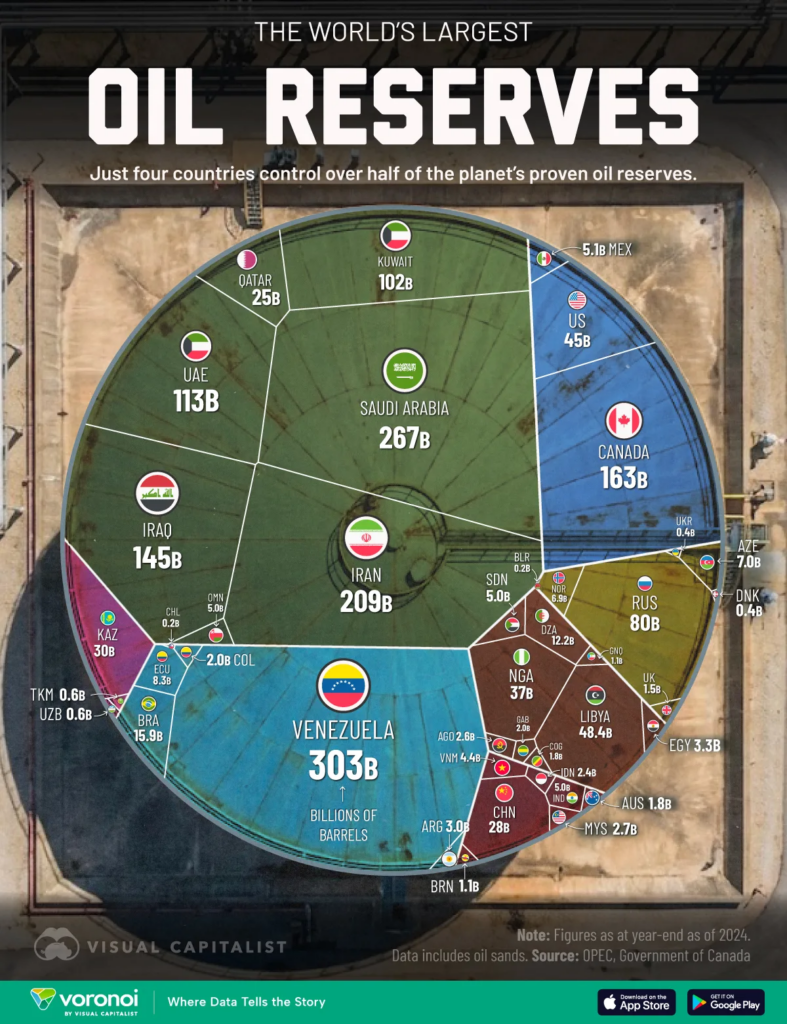
This contrast is important. Venezuela is not a marginal producer dealing with a temporary disruption. It is an energy giant that has effectively been immobilized.
And if that giant ever begins to move again, the consequences will extend far beyond Venezuela’s borders.
But not all oil is the same
Here’s where the story becomes slightly more technical, but it is also where India’s role starts to matter, so it is worth sticking with.
Crude oil comes in many varieties. Some are light and easy to refine, while others are thick, heavy and far more difficult to process. Venezuelan crude falls firmly into this second category.
It is heavy. It is sour, meaning it contains a high sulphur content. And it generates a significant amount of residue when refined. These characteristics make it unsuitable for processing at just any refinery.
Handling this kind of crude requires highly specialised infrastructure. Refineries need advanced equipment such as hydrocrackers, vacuum distillation units, desulphurisation systems and corrosion-resistant components capable of dealing with harsher inputs.
The oil industry captures this capability through a metric known as the Nelson Complexity Index, or NCI. A higher NCI indicates a more sophisticated refinery. Most simple refineries score around 2 or 3 on this scale. To process Venezuelan crude efficiently, however, a refinery typically needs an NCI of 10 or higher.
This is where India has a structural advantage
India, almost unintentionally, has built itself into one of the most complex refining hubs in the world. The reason is simple.
We do not have large domestic oil reserves of our own, so over time, Indian refiners designed plants that could process almost any kind of crude the global market offered. This strategy pushed complexity higher across the board.
Reliance’s Jamnagar refinery, for instance, has a Nelson Complexity Index of over 21, one of the highest in the world. Nayara Energy operates at a complexity level of around 12, while several public sector refineries also run at relatively high NCI levels.
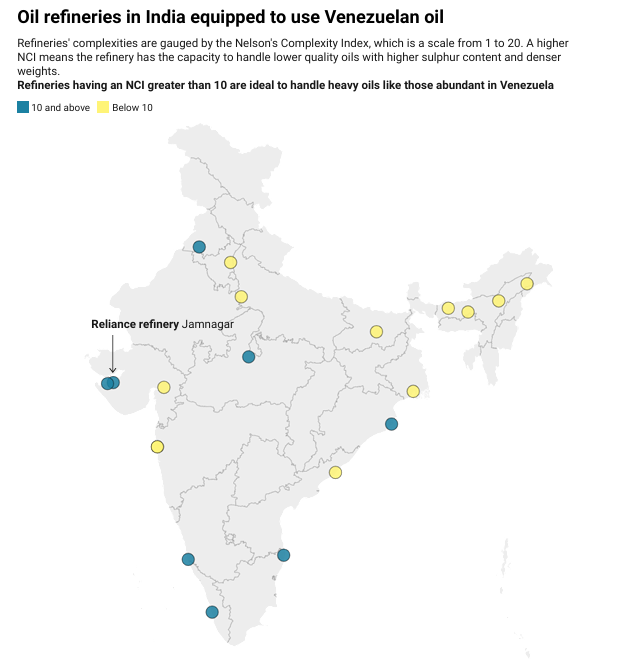
This capability means India is among the very few countries outside the US that can efficiently process Venezuelan heavy crude. Most countries simply lack the refinery infrastructure required to do so.
And if Venezuelan oil ever returns to global markets at scale, this refining strength becomes far more than a technical footnote.
There’s also Indian money stuck in Venezuela
Here is a part of the story that often gets overlooked. Indian companies are not merely potential buyers of Venezuelan oil; they are already investors on the ground.
ONGC Videsh, India’s overseas oil arm, holds stakes in two major Venezuelan oilfields namely San Cristobal and Carabobo-1. On paper, these assets are valuable. In practice, years of sanctions froze operations, prevented audits, and brought dividend payments to a halt.
As a result, nearly $1 billion in dues remains unpaid to Indian entities. Production at San Cristobal has fallen sharply to just 5,000-10,000 barrels a day, even though the field has the capacity to produce 80,000-100,000 barrels daily with the right equipment and fresh investment.
For years, this capital has effectively been locked away. Any meaningful change in Venezuela’s political situation or its sanctions regime will directly influence whether India is ever able to recover this money.
What a recovery in Venezuela would mean?
This is the real question. The US has made its intentions fairly clear. It wants to rebuild Venezuela’s oil sector, bring American oil companies back into the country and restore production over time.
Analysts estimate that Venezuelan output could rise to around 1.3-1.4 million barrels per day within the next two years. Over a longer horizon, possibly a decade, production could even climb to 2.5 million barrels per day if infrastructure improves and governance stabilises.
That is not a trivial increase. Additional oil supply generally eases pressure on global prices and gives large importers more room to manoeuvre in negotiations.
For India specifically, three things could change.
First, diversification. India has become heavily reliant on Russian oil since 2022, a strategy that worked well when discounts were steep. But geopolitical pressure has been building and Venezuelan crude could offer an alternative source of supply.
Second, bargaining power. When refiners have more options, they negotiate harder with traditional Middle Eastern suppliers. Even relatively small volumes from Venezuela could shift pricing dynamics at the margin
Third, the unlocking of older investments. If sanctions ease and payment channels normalise, Indian upstream investments in Venezuela could finally begin to generate returns instead of remaining frozen on balance sheets.
But this won’t be another Russia-style windfall
It is important to stay grounded. Venezuela is geographically distant and shipping crude from there to India takes close to 40 days, often costing $3-4 per barrel more than supplies from the Middle East.
Unless Venezuelan crude is offered at a meaningful discount, the economics will not always make sense.
There is also a new reality to consider. This time, India would not be dealing with a sanctioned outcast operating on the fringes of the global system.
It would be engaging with a framework shaped largely by the United States. Payments, contracts and access would likely flow through systems influenced by Washington.
That reduces sanction-related risks, but it also limits flexibility. Venezuelan oil, in this scenario, could become another geopolitical lever rather than a straightforward commercial opportunity.
So where does this leave India?
For now, Venezuela is largely a non-event when it comes to India’s immediate oil security. In the medium term, however, it represents optionality.
If Venezuelan production revives, if sanctions ease and if meaningful discounts emerge, India is uniquely positioned to benefit. Not because of political alignment, but because, years ago, it built refining systems capable of handling some of the world’s toughest crude.
That optionality does not guarantee gains. But it does provide leverage. And in global energy markets, leverage is often almost as valuable as oil itself.
The bottom line is straightforward. Venezuela is unlikely to move India’s oil needle tomorrow. But if the giant does wake up, India will be among the few countries ready to do business, quietly, confidently and on its own terms.