
Published on: August 28, 2025
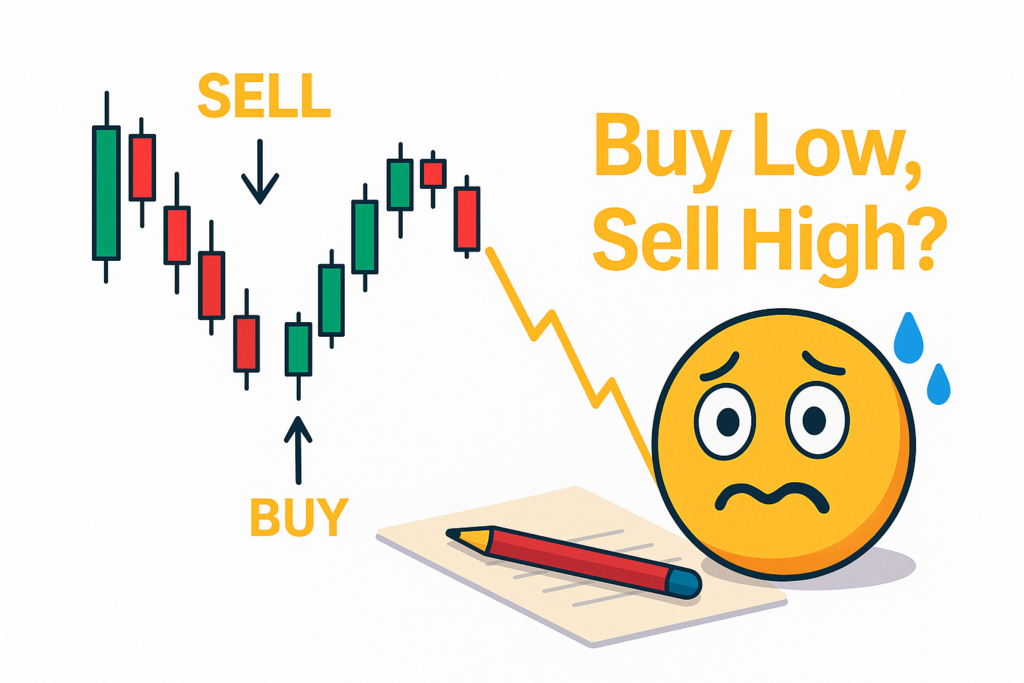
Everyone starts their trading and investing journey with only old mantra – buy low, sell high. Are you too one of them?
On paper, it sounds like the golden rule of trading but ask any veteran trader and you will hear how hard it is to actually do it.
As an old Dalal Street joke goes, the beginner asks, “How do I make money in the stock market?” The veteran replies, “That’s the simplest thing – buy low, sell high.” The young trader asks, “Yes, but how do I do that?” The reply: “That’s very difficult. It takes a lifetime to learn.”.
In other words, timing absolute bottoms and tops may probably look like an eagle eye in hindsight and make it look easy. In fact, studies show that waiting for the “perfect dip” can have unintended consequences. When markets fall, we tend to assume “this must be it”, only to see prices fall even more. As one analysis puts it, using past data to prove “buying in a correction made more money” is pure 50-50 hindsight.
I wish I had a Jay’s coin from the Sholay when the market dips. 😉
In practice, every trader faces uncertainty. What we think is a low can turn out to be a false bottom. You might buy a stock at ₹100 thinking it’s cheap, then wake up to ₹90 the next day, and ₹60 a week later. Or you see a stock spike to ₹200, sell at “high”, then miss out when it zooms to ₹280. The truth is, no one knows when the ultimate low or high has arrived. Legendary investors remind us that “buy low, sell high” isn’t about short-term price moves at all. For a typical trader in India, dealing in equities or Futures & Options, that distinction is crucial. Are you trying to time the market’s zig-zags or betting on long-term value?
The Real-World Snags
Let’s be frank – the markets are messy. Emotions run high. Fear and greed can send prices swinging wildly, especially in India, where a single RBI announcement or global cue can trigger sharp price movements. After a crash, everyone wants to buy the dip, but data shows that most investors actually stop buying or even sell after a recovery rather than taking that “buy low” chance.
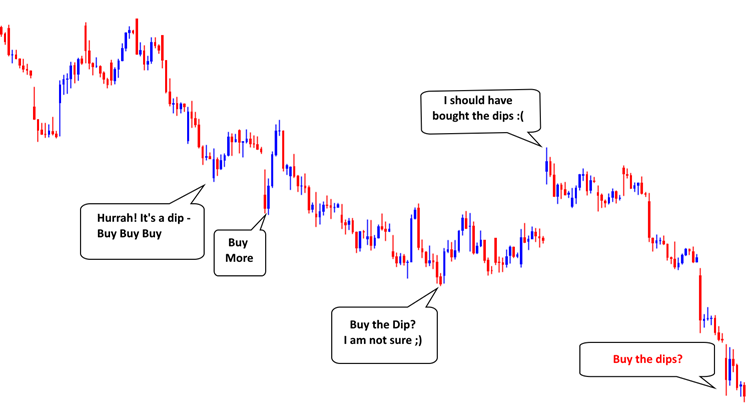
In other words, fear can cause traders to act contrary to their own mantra. As one study notes, market bottoms “are in fact opportunities disguised with feelings of fear and anxiety”. Yet it’s human nature to worry, “maybe it will fall further” instead of jumping in.
On top of emotions, traders must wrestle with technical issues. In F&O, timing matters even more. If you buy a call option expecting a rise, but implied volatility collapses or the move takes too long, you can still lose money even if the stock ends up higher. Theta (time decay) and margin requirements can turn a “buy low” strategy into a painful waiting game or a margin call. In short, even if you pick the right direction, leverage and time value make execution tricky. Many retail traders have learned this the hard way. It’s not enough to see a low, you have to act quickly and with enough confirmation.
Another pitfall is the invisible “fair value” barrier. For long-term investors (think Warren Buffett), “low” and “high” refer to value relative to a company’s business fundamentals, not the price fluctuations on charts. If you interpret “buy low” as just “buy when the share price is down,” you might miss that the stock was actually cheaper last month. As one analysis explains, buying at a “sensible” price is more important than nailing a chart bottom. In practice, this means that traders often end up buying after a rebound or selling too early, because the market doesn’t label a bottom in real-time.
Chart Tools: Noisy Signals and “Noiseless” Charts
So traders turn to technical analysis for help – charts, patterns, indicators, you name it, hoping to catch lows and highs. But even these tools have caveats. Many signals only become clear after the fact. This is why some traders (like those at Definedge Securities) use alternative chart styles to filter noise. For example, Renko charts draw bricks based purely on price movement, ignoring time and volume. Definedge notes that Renko charts “focus exclusively on price changes” and can give clearer trend signals.
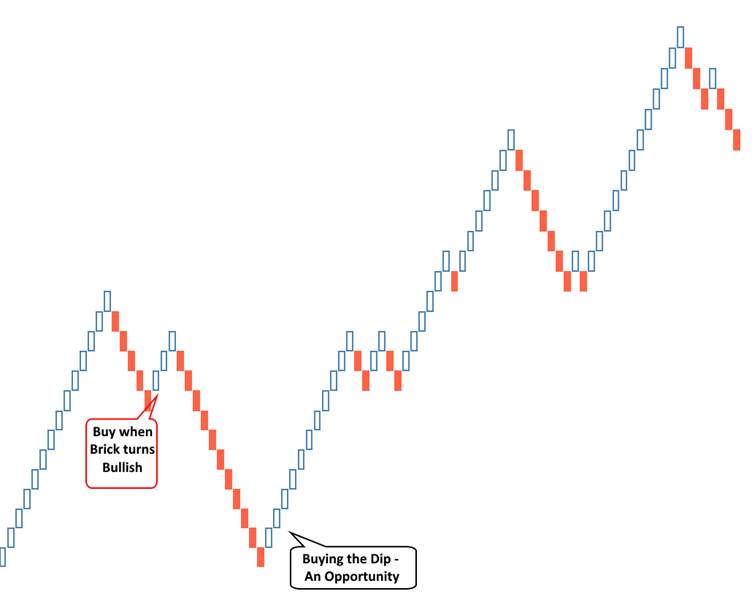
Similarly, Point & Figure (P&F) charts are called “noiseless” because they only mark significant moves. Combining a “noiseless” chart with indicators like RSI can sharpen the edge, but even then, no signal is infallible.
Learning to Trade the Process
So what’s the take-away? Don’t just blindly chase chart lows or highs hoping for instant riches. The “buy low, sell high” strategy sounds right, but it really means “buy better and sell better.” That involves:
- Having a clear plan. Set rules for entry, exit, and stops. Traders often use the above patterns in a checklist. For example, only buy a stock on a higher-low if volume or RSI also agree. Definedge emphasizes rule-based trading over gut calls – each trade should fit a template you’ve tested, not just a hunch.
- Using confluence. Combine indicators. A squeezed Bollinger band with an RSI divergence on a Renko chart is a stronger setup than any single signal alone.
- Managing risk. Even if a stock looks “cheap,” never risk so much that one bad trade wipes you out. In F&O, for instance, small moves can trigger big losses. Always use proper position sizing.
- Staying humble. The market is unpredictable. As one advice column puts it, investors should focus on fundamentals and fair pricing, not “guessing the future momentum”.
Traders at Definedge (and many educators) preach a “noiseless” approach: filter – out randomness and follow a process. However, Definedge warns that no system is foolproof. Patterns that look perfect can fail. For example, a triple top might reverse or merely pause before resuming its climb. A bullish chart break might be erased by a bad earnings report.
In summary, “Buy low, sell high” is a nice goal, but it’s simple, not easy. In real life, bottoms can get lower and tops can climb higher than you expect. The best strategy isn’t to blindly time swings, but to prepare, use chart patterns, key indicators, and strong risk controls.
Treat every “low” as a potential opportunity, but only after a reversal confirmation. Always be prepared to cut losses if a trade goes against you. Over time, that disciplined process, not perfect timing, is what really leads to gains.
