Published on: August 3, 2025

The Mirror Loop Theory is a behavioural concept in trading that explains a psychological loop where traders repeatedly react to the same stimulus with the same action despite expecting different results. It’s akin to being stuck in a “psychological mirror”; traders see a pattern, make a trade, incur a loss or suboptimal result, yet continue repeating the process with slight tweaks, believing that eventually, it will work in their favour.
This loop is powered by recency bias, confirmation bias, and the illusion of control. Traders convince themselves that one or two missed opportunities mean they are close to mastering the setup, without objectively analysing what went wrong.
Consequences of the Mirror Loop on Traders Psychology
The Mirror Loop leads to a false sense of pattern recognition. Instead of evolving, traders get caught in repeating cycles like:
- Chasing breakout trades every time a stock nears resistance, expecting a breakout based on a past missed opportunity.
- Ignoring stop-losses, believing “this time” the price will reverse in their favour.
- Overtrading, assuming that more trades will statistically even out earlier losses.
This can result in:
- Mental fatigue
- Loss of capital and confidence
- Confirmation-seeking instead of critical thinking
- Fear and greed cycles intensifying with each loop
Ultimately, traders become more reactive than strategic, trapped in a loop of emotional decision-making rather than rational evaluation.
Real Trading Examples from the Indian Stock Market
Let us explore a few real cases where traders may have fallen into the Mirror Loop.
a. YES Bank – The Illusion of Reversal
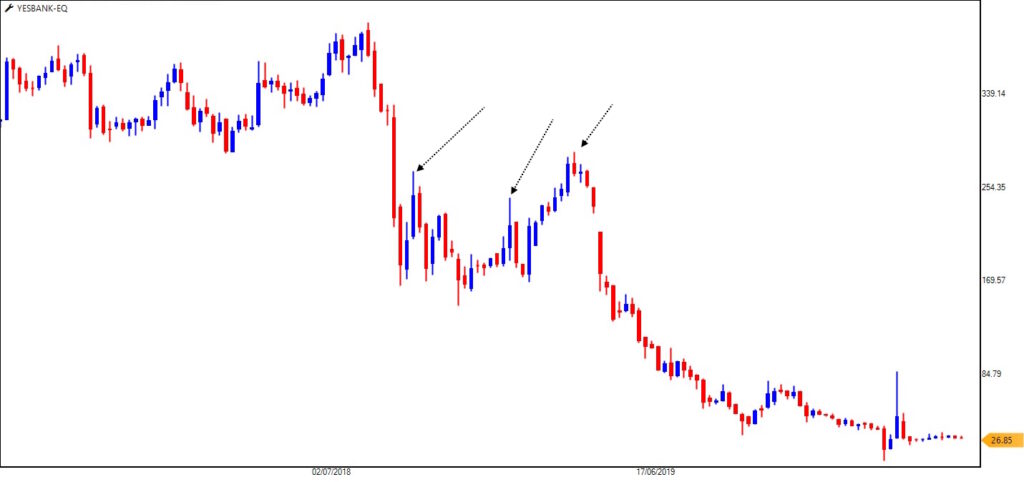
Dates: August 2018 to September 2019
Price Action: Fell from ₹400 (March 2019) to ₹29 (September 2019)
Mirror Loop Trigger: Every time YES Bank showed a 5–10-20% rally from a low, many retail traders jumped in, thinking the bottom was in place. They bought on hope, not confirmation.
Psychological Loop: The memory of its ₹400+ glory days lured traders into every bounce, expecting a reversal. But it continued its downtrend.
b. Adani Group Stocks – Post Hindenburg Report
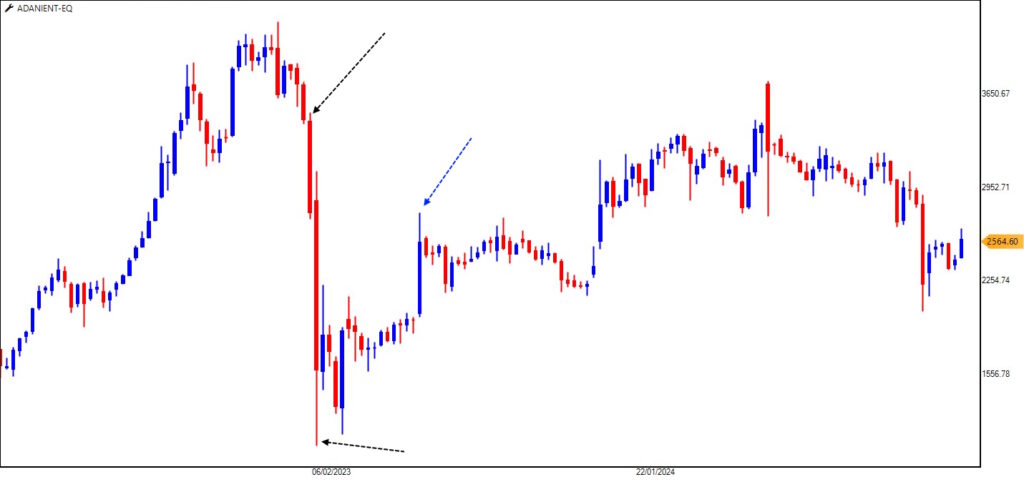
Dates: January to May 2023
Price Action: Dropped from ₹3,400 to ₹1,017, rallied to ₹2,700+, and fluctuated
Mirror Loop Trigger: Traders expected each bounce to sustain, based on the assumption that the worst news was priced in.
Psychological Loop: Anchoring to the pre-crash highs caused irrational hope-driven trading in every rally.
How Traders Can Overcome the Mirror Loop
Breaking the Mirror Loop requires traders to shift from emotional reaction to structured analysis.
Here’s how:
- Maintain a Trading Journal
- Record not just trades but why the trade was made—emotion or logic?
- Review losing trades to identify if they were part of a loop behaviour.
- Follow a Checklist-Based System
- Use filters: Entry triggers, volume confirmation, risk-reward.
- If 3 out of 5 criteria aren’t met, do not enter.
- Backtest Before Believing
- Don’t just act on recent memory. Use RZone to backtest patterns across timeframes and market cycles.
- Embrace Adaptive Thinking
- Markets evolve. A setup that worked 6 months ago may not now.
- Train your brain to let go of outdated patterns.
- Use Position Sizing
- Don’t bet heavily on the “this time it will work” belief.
- Use risk-defined sizes that protect your capital.
How Definedge Securities Can Help You Overcome the Mirror Loop
Definedge Securities provides a unique ecosystem that integrates technology, discipline, and market intelligence, critical to breaking the Mirror Loop.
1. RZone Scanners and Filters
- Use Volume Scanners, Breakout/Breakdown Filters, and Sector Rotation Scans to objectively identify setups, rather than relying on memory-based trades. There are 100s of scanners to scan from or create one.
- Avoid mirror-loop triggers by following data-backed trade entries.
2. TradePoint Technical Charts
- Use Point & Figure, Renko and Heikin Ashi charts to break free from traditional candlestick emotional biases.
- Multi-style charts help see through the noise and make better decisions.
3. Gurukul – Trader Education Hub
- Courses and mentorships designed to reprogram trading psychology, understand behaviour traps, and build robust strategies.
4. Position Sizing Tools in Zone Web
- Built-in execution tools that help you place trades based on your risk appetite and stop-loss distance, preventing overconfidence or desperation-based trades. Read more
5. Insights & Shelf
- Weekly technical reports, sector reviews, and curated trade ideas.
- Reading analysis based on pure technical principles can detach you from emotional biases and realign you with market structure.
Conclusion
The Mirror Loop Theory reveals the emotional treadmill many traders unknowingly run on, expecting different outcomes from repeated actions driven by emotion, not logic. By focusing on objective data, risk-managed strategies, and technical discipline, one can break free from the loop.
Definedge Securities, with its ecosystem of tools, education, and advanced charting, offers a pathway from emotional impulse to rational decision-making. It empowers traders to step away from the mirror and into the clarity of structured, intelligent trading.